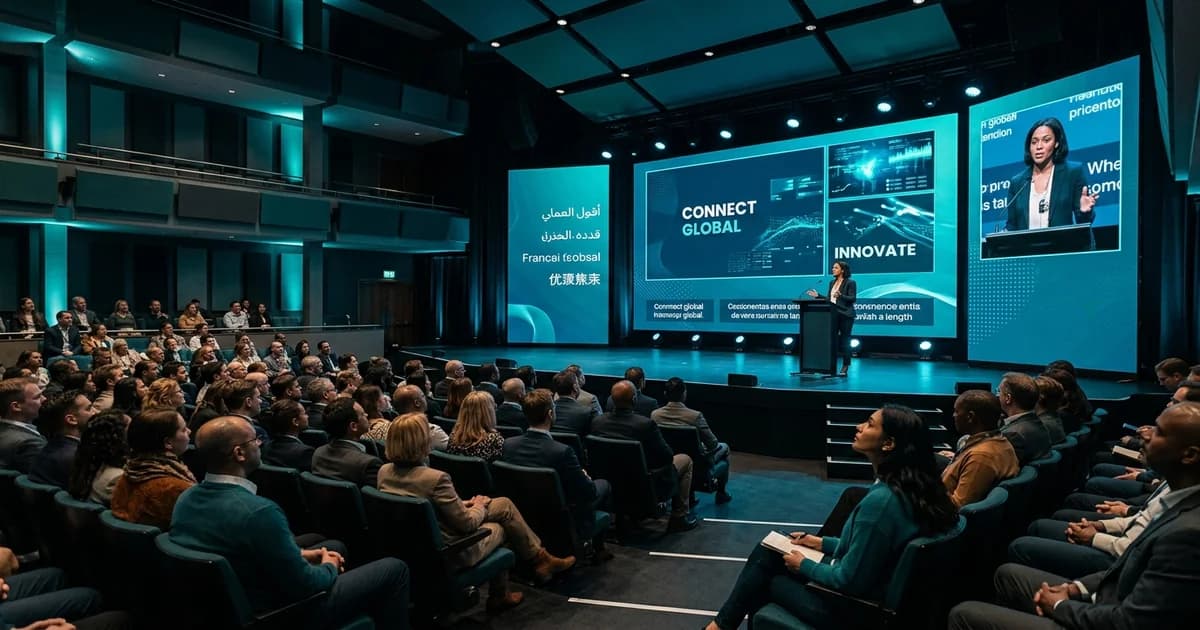
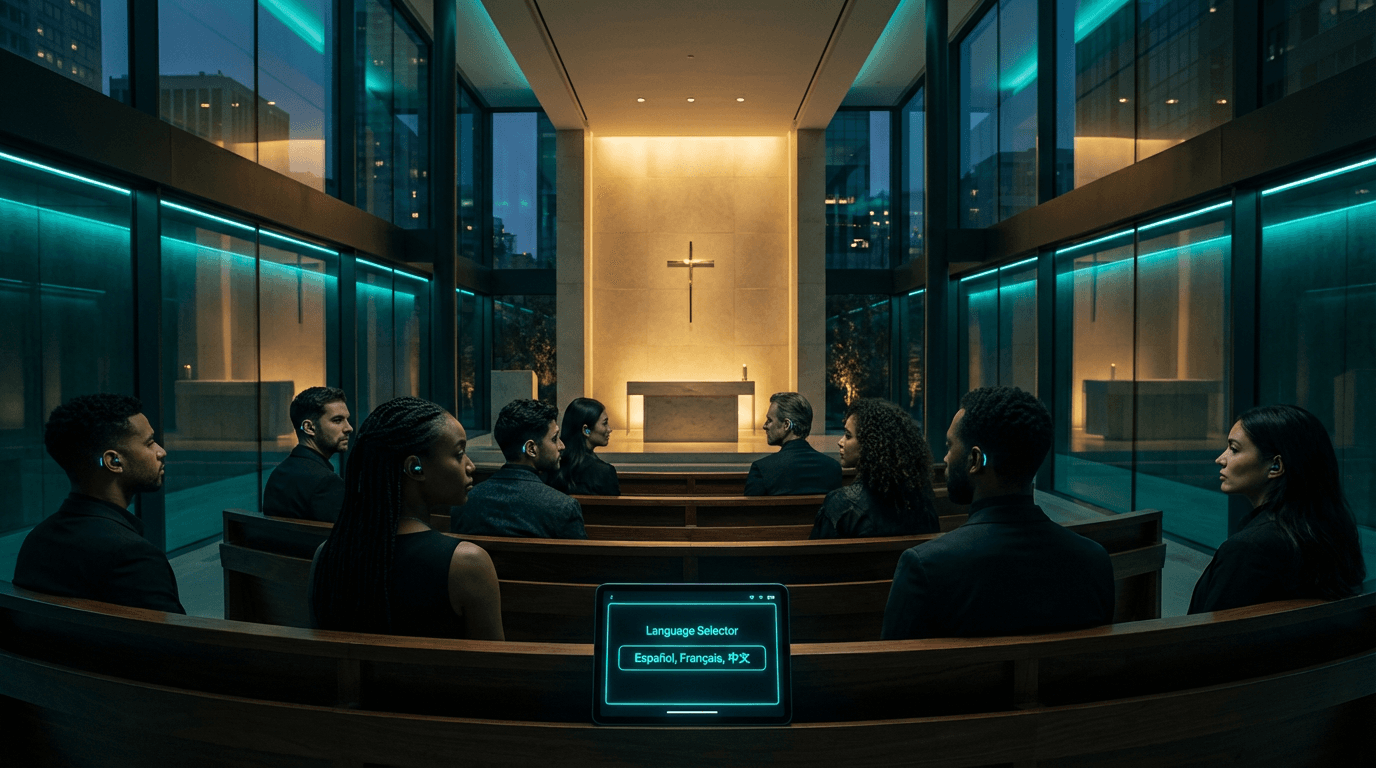
A church that gains a Spanish-speaking family, a Ukrainian group or a visiting delegation faces the same question every Sunday: how do they follow the sermon? Ten years ago the answer was a volunteer interpreter and a box of FM receivers. Today most options are church translation apps on the congregant's own phone, and prices range from a few pounds a week to several thousand dollars of hardware. The sections below cover the three kinds in turn: church-focused AI apps, event platforms, and hardware receivers.
This comparison lays out what each type of system actually costs, how many languages it covers and what your sound desk needs to feed it. Every figure comes from the vendor's own website as checked on 29 October 2026. Prices change, so treat them as a starting point and confirm with the vendor before you buy. We build Interpretwise, so we have included ourselves with the same scrutiny as everyone else, including where we are not the cheapest choice.
In short: a church-focused AI app costs from about $39 a month (ChurchTranslator.AI) or $5 per hour per language (Glossa); event platforms such as Interpretwise bill per hour of use, about €75 to €120 for a 90-minute service in two languages; an FM headset kit for four listeners costs $1,500 to $3,300 plus a human interpreter every week. All prices are as published on 29 October 2026.
How we compared these systems
We looked at six things that decide whether a translation system works in a church rather than in a demo:
- How congregants listen. QR code and phone browser, a downloaded app, or a loaned receiver with an earpiece.
- Languages. The number the vendor publishes, and whether it covers spoken audio or only captions.
- Published price. Only figures shown publicly. "Request a quote" is recorded as exactly that.
- Audio input. The hardware each vendor asks for between the mixing desk and the cloud.
- Integrations. ProPresenter, OBS, YouTube, Zoom and the encoder you already own.
- Stated limits. Accuracy caveats, hour caps, retention of recordings.
We did not score or rank vendors. A church with one Spanish group every week and a church hosting a 400-person conference have different right answers, and the sections below follow that difference.
Church-focused AI apps: published prices side by side
These five vendors publish their prices. All figures are the vendor's list prices as shown on its pricing page on 29 October 2026 (LiveInterpret.AI states its prices exclude VAT; the others do not state tax treatment).
| Tool | Languages (vendor figure) | Published starting price | Free trial | Listeners |
|---|---|---|---|---|
| ChurchTranslator.AI | 98 (Natural Voice) | $39/month: 6 service hours, 2 languages | First 4 hours, within 14 days | Unlimited |
| LiveInterpret.AI | 78 | €49/month for 450 language-minutes, or packs from €19 | 30 language-minutes | Unlimited |
| Glossa | 100+ | $5 per hour per language, or $99/month for 25 hours | 4 hours | Unlimited |
| OneAccord | 50+ | From $150/month for 5 hours | Some free credits, on request | Not published |
| Voco (text only) | 200+ | £6/week | 7 days | Unlimited |
A few details behind the numbers matter more than the headline price:
- Units differ. ChurchTranslator.AI counts service hours once on its three lower plans, however many languages run (its VIP plan adds a 150 language-hour allowance, billed at $3 per language-hour beyond that). LiveInterpret.AI and Glossa bill per language-minute or language-hour: a 90-minute service in two languages is 180 minutes on LiveInterpret.AI (about €15 to €23 at its pack prices, by its own example) and 3 translation hours on Glossa.
- Overage. ChurchTranslator.AI charges $4.50 per extra service hour. LiveInterpret.AI's overage is €0.08 to €0.11 per language-minute and stays off until you enable it.
- Voice options are tiered. ChurchTranslator.AI's "Steady voice" is a $9 or $19 add-on depending on plan. Glossa's speaker-modelled voice sits on its Advanced and Premium plans.
- Text only is cheaper. Voco is a text-only service by its own description, with no spoken audio. If reading on a phone is acceptable, it has the lowest published weekly subscription price in this table.
spf.io does not publish prices. Its supervised mode, where an operator corrects the AI live, is unusual in this group and worth asking about if you want a person checking scripture references as they are translated; its published client review from FAC Calgary describes one operator running 60 languages.
Wordly and KUDO: event platforms with church packages
Wordly publishes a church page with three packages: Start at 60 hours a year, Expand at 120 and Wide Adoption at 300, all on 12-month terms. The church page shows no dollar amounts, but Wordly's general pricing page states that pricing starts at about $1,500 for a 10-hour package, with a 10% non-profit discount from its 25-hour tier. Wordly is AI-only, covers 61 input and 67 output languages by its own language list, and holds SOC 2 Type II and ISO 27001 certifications. Timberline Church in Fort Collins, Colorado, is one of its two published church case studies.
KUDO does not publish prices and sells annual plans from 50 hours a year. Its distinctive asset for churches is a marketplace of human interpreters that can be booked alongside, or instead of, its AI translator. If your church already works with a human interpreter for a Deaf or hard-of-hearing group, KUDO's human side covers sign languages, which none of the AI tools in this article do.
Interpretwise: where it fits a church and where it does not
Interpretwise is a pay-per-use event platform rather than a church subscription, so it is fair to show both what you get and what it costs. Congregants scan a QR code and listen in the browser with live captions; no app, no receivers, and the first 100 concurrent listeners are included in the platform fee. The standard live catalogue covers 30-plus languages, and the engine behind it supports more than 80, which we enable per event on request.
Five things are included that churches usually ask about:
- Premium voices. There are two voice tiers: Standard, which covers the full language range at a lower price, and Premium, natural-sounding voices we recommend for anything heard from the stage or on a stream. You can hear both in the unedited replays on our examples page before paying anything.
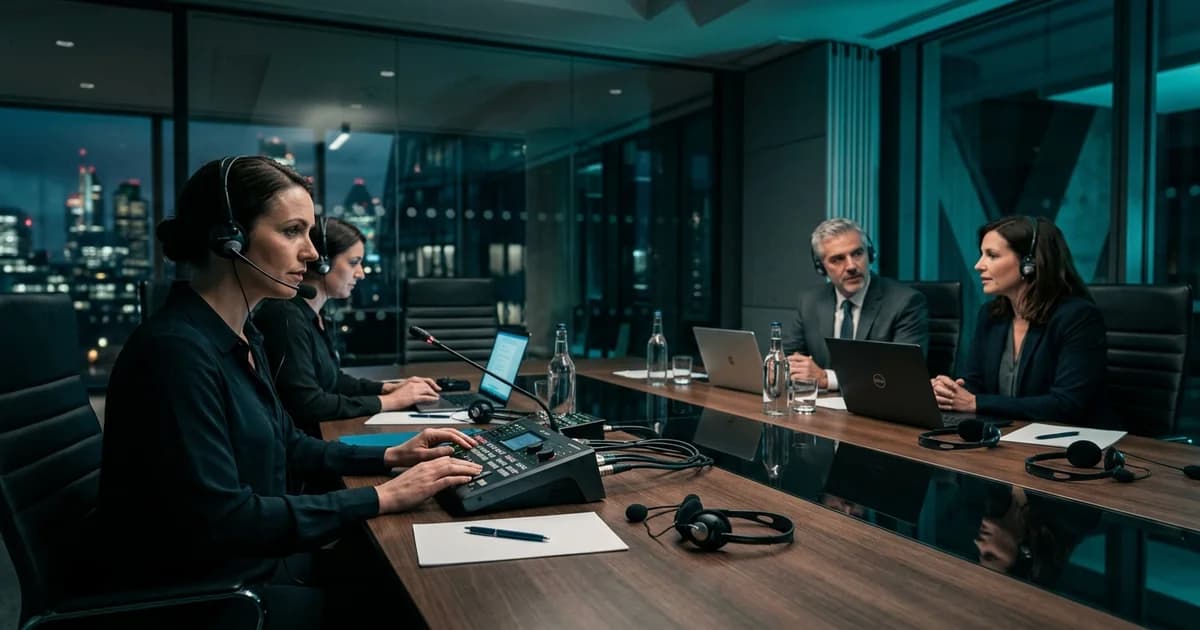
- A human interpreter on the same system. For a language where you want a person, the interpreter works from a browser-based console while AI covers the other languages, and congregants switch channels on the same listen page.
- A dubbed stream for every language. One RTMP output per language to YouTube or any RTMP destination, with the translated audio synced to the video.
- Multichannel audio for the sound desk. The Mac desktop console takes the floor from any input channel and sends each language to its own output channel, for hearing loops, headset transmitters or the stream mix.
- A latency report after every session, so you know exactly how far behind the speaker each language ran, instead of guessing.
The rate card is public and billed per started minute, before VAT: platform fee €15 per hour including the first 100 concurrent listeners; live transcription €5 per hour per source language; AI translation €10 per hour per target language; voices €5 (Standard) or €20 (Premium) per hour per voiced language; human interpreter channel €15 per hour per language, with the interpreter's own fee separate.
A 90-minute service in two languages with Standard voices therefore costs about €75; with Premium voices, about €120. For a weekly service, that is more than ChurchTranslator.AI or LiveInterpret.AI charge, and we would not pretend otherwise. New accounts get a €25 welcome credit to test a real service without entering a card, onboarding and a technical rehearsal are free, and non-profit organisations can ask for a discounted rate.
Where Interpretwise is the better fit is the event side of church life: a conference with a dozen languages, a hybrid service with an interpreter for one language and AI for the others, a livestream that needs translated audio rather than captions alone, or a sound team that wants each language on its own channel. For those specific jobs, check each weekly-service app's integrations page rather than assuming it covers them.
Headset systems: what hardware still costs
Receivers have not disappeared, and for older members who do not want a phone in their hand during worship they remain the most comfortable option. Published prices as of 29 October 2026:
- Williams AV Digi-Wave (2.4 GHz): vendor-listed bundles from $3,595 for 10 receivers to $21,995 for 50 rechargeable receivers.
- Williams AV FM 558 PRO (FM, 17 channels, 4 receivers): $3,065 at one US reseller; the FM 558 PRO D variant is $3,315 at another.
- Listen Technologies LS-31-072 (3-channel FM transmitter, 4 receivers): $1,499 to $1,679 at resellers (list price $1,909); the LT-800 transmitter alone offers 57 channels and about 300 metres of range.
Listen's own case study, Walnut Street Baptist Church in Newark, runs one transmitter and 10 receivers for Portuguese-to-English. The constraint is the interpreter: hardware carries a human voice and translates nothing itself, so every language needs a person every week.
Audio feed: the part that decides whether any of this works
The vendors that publish a setup guide say the same thing in different words: the system is only as good as the sound you feed it. The specifics they publish are useful because they tell you what to buy before the first Sunday.
- A line-level feed from the mixing desk. Wordly's in-person guide asks for the mixer's AUX or headphone output through an audio interface such as an iRig 2, and warns against the device's built-in microphone. ChurchTranslator.AI asks for a USB interface or mixer line out into a booth computer; LiveInterpret.AI asks for a sound feed from the mixing desk into its sender app, a phone browser or an RTMP encoder.
- A computer or phone at the desk. spf.io specifies a modest PC with Chrome and USB audio; LiveInterpret.AI offers a free sender app or an RTMP feed from OBS or vMix.
- Bandwidth. Wordly states 5 Mbps up for the presenter device and 3 Mbps per attendee. The Wi-Fi in a full sanctuary is the practical limit for every tool: if 200 people open a browser at once, test it before the service.
- Speaker language. Wordly notes that quality drops when a speaker uses a language other than the one set. LiveInterpret.AI auto-detects the speaker's language; KUDO's detection handles up to 10. Ask how each tool copes with a bilingual testimony or a guest preacher.
Captions, screens and the livestream
Most churches want three outputs from the same feed: audio in the congregant's ear, captions on the main screens, and the same thing on the YouTube or Facebook stream.
- Screens. spf.io's Projector View shows up to four languages at once. ChurchTranslator.AI, Glossa, OneAccord and Voco publish ProPresenter or OBS integrations. Wordly can show captions on in-room monitors.
- Livestream audio. Here the field thins out. Interpretwise publishes one RTMP output per language, so a Spanish YouTube stream carries Spanish audio synced to the video. ChurchTranslator.AI offers YouTube audio tracks through its dubbing workflow for selected churches. Wordly documents RTMPS as an input and publishes no dubbed RTMP output.
- Recordings. ChurchTranslator.AI states it does not record the live service server-side and deletes replays after 48 hours. LiveInterpret.AI states no audio is written to disk and its servers are in Germany. Wordly's privacy policy states that personal data is stored in the United States, and it publishes no retention period for audio. Interpretwise records only when recording is switched on for the session.
Choosing: four typical churches
One language group, every Sunday, tight budget. A church-focused AI app. ChurchTranslator.AI at $39 a month, Glossa at $5 per hour per language or LiveInterpret.AI's €19 pack for occasional use are among the lowest published entry points for spoken translation; Voco at £6 a week if text on a phone is enough.
Several language groups and a tech volunteer who likes control. Glossa or spf.io, both of which lean on ProPresenter and OBS workflows, or ChurchTranslator.AI's Pro plan with six languages. Compare per-language billing against per-service billing with your real numbers.
Older congregation, one interpreter, no phones in the pew. A Listen or Williams AV FM kit: about $1,500 to $3,300 for a 4-receiver starter kit at published reseller prices, plus a human interpreter every week.
Conferences, denominational gatherings, hybrid services with a human interpreter. An event platform. Interpretwise if you want pay-per-use pricing, a human channel next to AI and per-language livestream outputs; Wordly if you prefer an annual hour package and its published SOC 2 and ISO 27001 certifications; KUDO if you need booked human interpreters including sign language.
Frequently asked questions
Do congregants need to download an app?
For the AI tools in this article that publish their listener setup, no: congregants scan a QR code and listen in the phone browser. ChurchTranslator.AI, Wordly, KUDO and Glossa also offer optional apps. Hardware systems need no phone at all, only the loaned receiver.
How much delay should we expect?
The vendors that publish a figure range from about four seconds to fifteen. KUDO states an average of 4.1 seconds; LiveInterpret.AI states 5 to 15 seconds; Wordly says audio plays after each sentence is completed. Interpretwise runs a few seconds behind the speaker and shows a latency report after each session. Test with a responsive reading or a song, where any delay is most noticeable.
Is AI translation accurate enough for scripture and sermons?
Accurate enough for the congregation to follow, not word-perfect. Several vendors here say accuracy depends on audio quality and the language pair, and several offer glossaries so names, books of the Bible and doctrinal terms are rendered consistently. Our advice is to listen to a real recording in your language before deciding; our examples page has unedited replays for exactly that purpose.
What does a human interpreter cost compared with AI?
The platforms do not publish interpreter rates, and freelance rates vary by language and country. The structural difference is that hardware and KUDO's marketplace price the human per hour per language every week, while AI apps price the hours or minutes and add languages cheaply. Our guide to interpretation costs walks through the arithmetic for events.
Can we use the same system for the livestream?
Partly. Captions on the stream are common; translated audio on the stream is rarer. Of the tools here, Interpretwise publishes per-language RTMP outputs for YouTube and custom destinations, and ChurchTranslator.AI offers YouTube audio tracks through its dubbing workflow. Confirm the exact mechanism with the vendor rather than assuming.
Every price and language count above was checked on 29 October 2026 on the vendor's public site; if you represent one of these companies and a figure has changed, write to us and we will correct it. Our earlier guide to church translation systems covers the room setup in more depth, and the AI versus human interpretation article explains when a person in the booth is still the right answer. If your church is planning a conference or a service with a human interpreter alongside AI, contact us and we will set up a test session with your languages, or listen first on the examples page.
Related Articles