

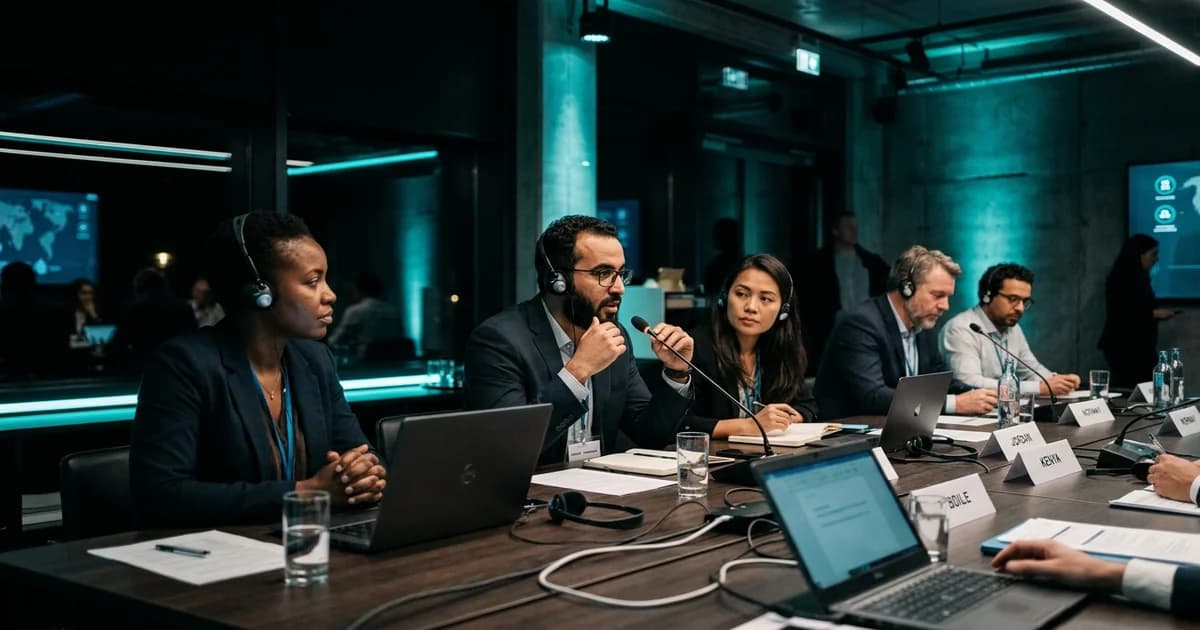
Your team is on the ground, ready to launch a project that will change lives. You've secured the funding, organized the logistics, and built relationships. But there's a gap. The community you're here to serve speaks a different language, and the nuances of their needs, fears, and hopes are getting lost. You're relying on a local volunteer who is trying their best, but you can't be sure if the true meaning is getting through. Does this sound familiar?
For NGOs and non-profits, communication isn't just part of the mission—it is the mission. Yet, language barriers can undermine the most well-intentioned work, creating distance when you need connection. For too long, professional interpretation seemed like a luxury reserved for massive international summits. It was expensive, complicated, and required stacks of hardware.
That's not the world we live in anymore.
This guide is for you. It’s a practical look at how modern, affordable interpretation can stretch your budget and amplify your impact. Forget the old way of doing things. Let's explore how you can connect with anyone, anywhere, in any language.
The Unique Communication Challenges Faced by NGOs
The communication needs of a non-profit are unlike any other sector. You're not just selling a product; you're building trust, delivering critical aid, and advocating for human rights. The stakes are incredibly high.
One of the biggest hurdles is the sheer diversity of stakeholders. A single project might require you to speak with:
- Local communities: To gather feedback and ensure your programs are culturally relevant and genuinely needed.
- International donors: To report on your impact and secure future funding.
- Global staff and volunteers: To coordinate efforts across different regions and time zones.
- Policymakers: To advocate for systemic change based on your findings.
In these sensitive contexts, "good enough" communication can be dangerous. Research from CLEAR Global, an NGO focused on language, found instances where mistranslation had severe consequences. In one case, the phrase "violence against women" was incorrectly rendered as "violent women," completely distorting the meaning and potentially preventing vulnerable individuals from seeking help. This highlights a critical point: using untrained staff, local volunteers, or family members as interpreters, while well-intentioned, is a huge risk. They aren't equipped to handle the pressure and complexity of professional interpreting.
Furthermore, language often becomes a barrier to the very people you're trying to help. Studies in regions like the DRC have shown that when aid workers speak a language associated with authority or outside groups, it can undermine trust and foster suspicion. To achieve your mission, you need to communicate with dignity, accuracy, and an understanding of cultural context.
How Technology is Making Professional Interpretation More Accessible
So, what's the solution when budgets are tight but the need for clear communication is absolute? The answer lies in technology. The global language services market is projected to grow to over $81 billion in 2026, largely driven by digital innovation. This has forced a massive shift away from the old, cumbersome model of interpretation.
Remember the days of needing to fly interpreters across the country, rent expensive soundproof booths, and hire technicians to manage complex hardware? For most NGOs, that was never even an option.
Today, modern browser-based interpretation platforms have changed everything.
You can now set up a professional, multilingual event or meeting in as little as 15-30 minutes. Attendees don't need to download a special app; they can simply scan a QR code with their smartphone and immediately access live audio interpretation in their chosen language. This ease of access is crucial for community outreach and fieldwork.
These platforms are built to integrate directly with the tools you already use, like Zoom, Teams, Google Meet, and YouTube Live. And they can scale from a small team meeting of 20 to a global conference with over 5,000 attendees, supporting 20 or more languages simultaneously. Many also include live captions/subtitles, making your content accessible to an even wider audience, including those who are deaf or hard of hearing. This is how remote simultaneous interpretation for NGOs becomes not just possible, but practical.
Stretching Your Budget: How to Plan for Language Services in Grant Proposals
Too often, language access is treated as an afterthought—a line item that gets cut when the budget gets tight. To truly serve a multilingual community, you need to build interpretation into your project from the very beginning. And that starts with your grant proposals.
Framing interpretation as a core component of your impact strategy—rather than an operational cost—is key. Here’s how to plan for it:
- Assess the True Need: Before you write a single word of your proposal, identify the primary languages and dialects of the communities you serve. Don't guess. Conduct a real needs assessment. This data will be the foundation of your justification.
- Research Modern Solutions: Get a realistic estimate of what it will cost. Explore current platforms to see how affordable remote interpretation can be. Instead of budgeting for flights and hardware, you can now budget for a flexible subscription or per-event service.
- Itemize the Cost Clearly: Don't just put "Translation - $1,000." Be specific. A strong proposal itemizes the need. For example: "Remote simultaneous interpretation for six community feedback sessions in Swahili, French, and Lingala" or "Live AI interpretation and subtitles for our annual virtual fundraising gala in 15 languages."
- Justify the Expense as Impact: This is the most critical step. Connect the dots for your funders. Explain that providing professional interpretation is a direct investment in equity, inclusion, and effectiveness. It ensures you can collect accurate data, build genuine trust, and design programs that truly meet the community's needs. It proves your commitment to leaving no one behind.
When you make a compelling case, funders will see language access for humanitarian aid not as an expense, but as an essential tool for maximizing the return on their investment.
Hybrid Solutions: Combining AI and Human Interpreters for Maximum Affordability
The conversation around interpretation technology is often framed as AI versus humans. But that’s a false choice. The smartest, most cost-effective approach for non-profits is a hybrid one.
AI interpretation has made incredible strides. It is fantastic for:
- Scale and Speed: Instantly providing real-time audio and text translation in dozens of languages.
- Accessibility: Automatically generating live captions and subtitles for every session.
- Cost-Efficiency: Covering broad-stroke communication, like a general presentation at a conference or an internal all-staff update, at a fraction of the cost of human interpreters.
However, AI still struggles with the things that matter most in sensitive situations. It can't grasp cultural nuance, emotional intent, or the subtle subtext of a conversation. A 2026 peer-reviewed study confirmed that in complex, high-stakes settings, audiences listening to professional human interpreters had significantly better comprehension than those listening to an AI system.
This is where human interpreters are irreplaceable. For high-stakes legal, medical, or diplomatic conversations—or for deeply personal fieldwork interviews—you need a human expert who can interpret not just words, but meaning.
The hybrid model gives you the best of both worlds. Imagine hosting a large-scale community health forum:
- You use AI interpretation to broadcast the main presentation in 20 languages, with live subtitles for all. This ensures the core information is widely accessible and is incredibly affordable.
- Then, for the breakout Q&A sessions where community members share personal health concerns, you switch to professional human interpreters for specific languages. This provides the empathy, confidentiality, and accuracy required for such a sensitive topic.
This is the future of non-profit interpretation. It's about using the right tool for the right job to stretch every dollar without sacrificing quality where it counts.
Case Study: A Human Rights NGO's Approach to Multilingual Fieldwork
Let's look at a real-world example. A (fictional) human rights organization, the "Global Dignity Project," needed to document testimonials from displaced persons in a region where three distinct dialects were spoken.
The Old Way: In the past, they would have flown in a single, expensive interpreter who was fluent in only one of the three dialects. For the other two, they relied on local contacts who were not trained in the ethics or techniques of professional interpretation. This led to inconsistent data, potential re-traumatization of interviewees, and hours of wasted time.
The New Hybrid Approach:
Using a modern, browser-based platform, the field team transformed their process.
- Remote Human Interpretation for Interviews: Fieldworkers used tablets with a stable internet connection to connect with professional, vetted human interpreters remotely. They could schedule three separate, specialist interpreters for each dialect, ensuring every interview was handled with precision and empathy. There were no travel costs, and the quality of their data improved dramatically.
- AI Interpretation for Community Briefings: Later in the project, the team held large community briefings to share their findings and provide information on accessing legal aid. For these one-to-many sessions, they used the platform's AI interpretation feature. Attendees simply scanned a QR code on a flyer to hear the information in their native language and see live subtitles on their own phones.
The Result: The Global Dignity Project saved thousands on travel and logistics. More importantly, they built deeper trust within the community and collected highly accurate, consistent testimonials. This stronger evidence directly supported their advocacy work with international policymakers. This is a clear example of using humanitarian interpreting solutions to drive tangible outcomes.
Your mission is too important to be lost in translation. With today's technology, professional interpretation is no longer out of reach. It’s a powerful, affordable tool to connect with your community, scale your impact, and give a voice to the voiceless. If you're ready to see how a simple, browser-based platform can work for your organization, let's talk. You can get a quote tailored to your specific project needs.
FAQs: Interpretation for the Non-Profit Sector
How much do interpretation services for a non-profit really cost?
This is the big question, and the answer is: it depends. The cost is based on factors like whether you need human or AI interpreters, the number of languages, and the duration of your event. However, modern platforms have made it dramatically more affordable. Instead of the old model of high day rates for in-person interpreters, you now have flexible options that can be tailored to your budget, making professional affordable interpretation a reality.
Can we just use a bilingual staff member for interpretation?
While it seems like a free solution, it often comes with hidden costs. Being bilingual is different from being a trained interpreter. Professional interpreters have skills in memory, note-taking, ethics, and handling high-pressure situations. Asking a staff member to interpret puts them in a difficult position, can lead to burnout, and takes them away from their primary duties. Most importantly, it risks inaccurate communication in critical moments.
What's the difference between interpretation and translation?
It's simple: interpretation is for spoken language, while translation is for written text. An interpreter works in real-time at your live event or meeting. A translator works with documents, websites, and reports.
How do I ensure interpretation is inclusive for everyone at our event?
Great question! Inclusivity is about ease of access. Look for a solution that is 100% browser-based, meaning no one has to download an app. A system using a simple QR code allows anyone with a smartphone to join the language channel instantly. Also, ensure the service includes live captions to support attendees who are deaf, hard of hearing, or simply prefer to read along.
Related Articles

AI vs Human Interpretation: Which Is Right for Your Event?
Conference Interpretation Cost: A Complete 2026 Pricing Breakdown

The True Cost of Interpretation Booths (And How to Cut It by 80%)

How to Choose an Interpretation Service: 10 Critical Questions
What is Whispered Interpretation (Chuchotage)? A Guide for Small Meetings
Beyond Spanish: How Language Pair Rarity Impacts Interpretation Costs

The Interpreter Shortage: How Technology Can Bridge the Gap for Event Organizers