


You’ve done it. You’ve secured the speakers, booked the venue, and the registration numbers for your international conference are climbing. But there’s a nagging problem that keeps you up at night: language support. You need to find conference interpreters for a handful of languages, but your go-to agency is quoting longer lead times and higher prices. You’re not imagining it.
Finding qualified, available interpreters is getting harder. There's a global conference interpreter shortage brewing, and it’s putting pressure on anyone organizing multilingual events. But it’s not an unsolvable problem. In fact, the challenges of the last few years have pushed the industry forward. Technology—specifically remote and hybrid interpretation solutions—offers a powerful way to bridge this growing gap, ensuring your event is as inclusive and seamless as you envisioned.
What's Causing the Global Shortage of Conference Interpreters?
So, where have all the interpreters gone? The issue isn't a sudden lack of interest in the profession. Instead, it’s a "leaky pipeline" caused by a perfect storm of factors.
For years, a significant portion of the most experienced conference interpreters has been nearing retirement age. One recent discussion noted that around 30% of interpreters are over 40, signaling a massive wave of retirements over the next decade or so. Simultaneously, fewer people are entering and—more importantly—staying in the field to replace them.
Why? Interpreter burnout is a major reason. The work is incredibly demanding, requiring intense mental focus to listen, process, and speak in two languages at once. Long hours, back-to-back sessions, and the emotional weight of interpreting in high-stakes environments lead many to leave the profession within a few years. The pandemic made things worse, pushing many interpreters out of the field due to health concerns or the unique stress of early virtual interpreting setups.
On top of that, barriers to entry are high. Becoming a professional interpreter often requires advanced degrees and rigorous certifications, which can be expensive and time-consuming. When you combine that with the often-inconsistent nature of freelance work, it’s easy to see why the talent pipeline is struggling to keep up with demand.
The Impact on Event Budgets and Lead Times
This shortage isn't just an abstract industry problem—it has direct, tangible consequences for event organizers. The most immediate impact is on interpreter availability and your budget.
With a smaller talent pool, the lead times for booking qualified professionals have shot up. It’s no longer a simple task to find a team of interpreters, especially for events requiring multiple or rare languages. Need a specialist with deep knowledge of medical device regulations who can interpret into Japanese? Or a legal expert for a German-language panel? That search has become much more competitive.
This scarcity naturally drives up costs. Basic supply and demand mean that as interpreter availability shrinks, rates for top-tier talent increase. One analysis pointed to a staggering 53% increase in average referral agency rates between 2012 and 2024. For event organizers, this translates to bigger line items for language services, forcing tough decisions about where to allocate funds. You might find yourself having to choose between cutting a language or compromising on the quality of the interpreter—a choice no one wants to make.
Last-minute requests, once merely difficult, are now nearly impossible to fill without significant budget implications. The days of securing a full team of interpreters with just a few weeks' notice are fading fast.
How Remote Interpretation Platforms Widen the Talent Pool
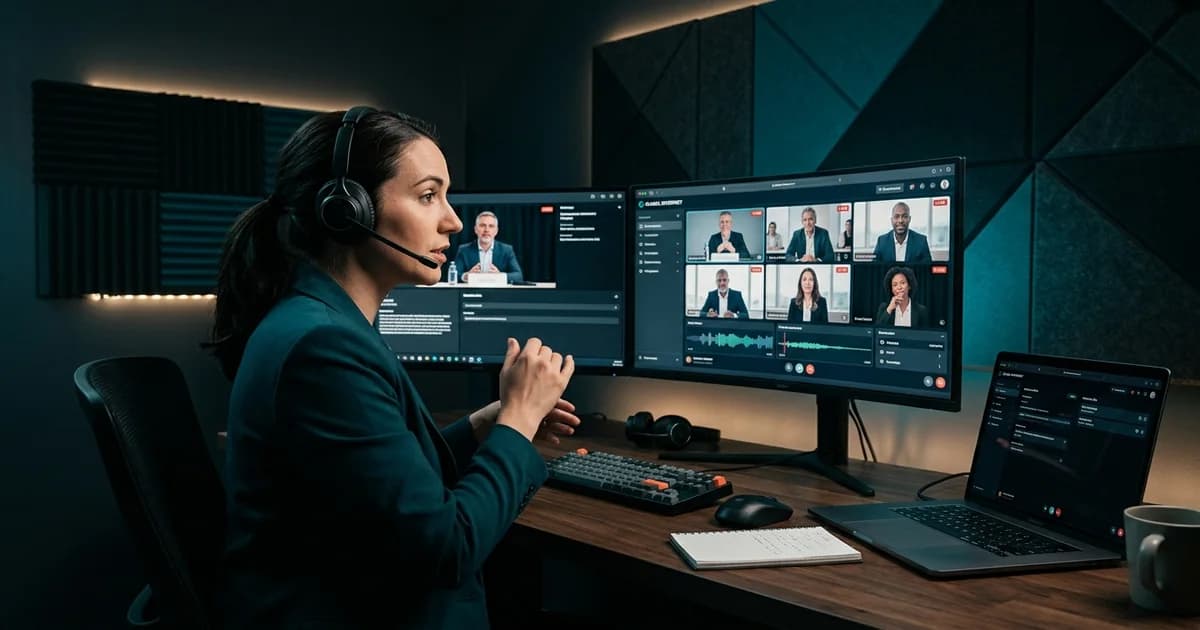
Here’s the good news. You're no longer limited to the interpreters who live within a 100-mile radius of your venue. The rise of remote simultaneous interpretation (RSI) platforms has completely changed the game for event staffing solutions.
Instead of flying interpreters across continents—with all the associated costs for flights, hotels, and per diems—you can now access a global network of professionals who work from anywhere. This is possible through 100% browser-based platforms that don’t require any special hardware for your interpreters or attendees. The interpreter for your Parisian event could be in Tokyo, and the attendees in Berlin can listen in on their own smartphones with a simple QR code scan.
This approach solves several problems at once:
- Vastly Expanded Talent Pool: You can find the best interpreter for your subject matter, not just the closest one. This is critical for technical, medical, or financial conferences where specialized terminology is everything.
- More Language Combinations: Access to a global pool makes it easier to support more languages, including less common ones. Running an event with 20+ languages simultaneously is now a practical reality.
- Significant Cost Savings: By eliminating travel and accommodation expenses for interpreters, you can redirect that budget toward securing top talent or enhancing other parts of your event.
- Improved Interpreter Work-Life Balance: Remote work offers interpreters more flexibility and a better work-life balance, which can help combat burnout and keep more professionals in the field long-term.
Suddenly, the world of language talent is open to you. It's a more sustainable, flexible, and efficient way to staff your multilingual events.
The Role of AI-Human Hybrid Solutions in Filling Gaps
The conversation around AI often gets stuck on a simple question: will it replace humans? The reality, especially in the world of interpretation, is far more nuanced. While AI is not ready to replace human interpreters in situations that demand cultural understanding, emotional intelligence, and context, it has become an incredibly powerful tool. The future isn't AI versus human; it's AI and human, working together.
This is where an AI-human hybrid interpretation model comes in.
Think about your event. You might have a high-stakes keynote speech where conveying every nuance and emotion is critical. That’s a job for a professional human interpreter. But what about smaller breakout sessions? Or what if you simply want to offer live captions (subtitles) as an accessibility feature for all attendees?
This is where technology can fill the gaps.
- AI for Accessibility: AI-driven translation can provide live captions in multiple languages, making your event more accessible to a wider audience, including those who are hard of hearing.
- AI for Lower-Stakes Sessions: For more informal or internal meetings, AI interpretation can be a cost-effective way to provide language support where it might have been previously unfeasible.
- Human Interpreters for High-Stakes Moments: For your main stage, panel discussions, and critical negotiations, you can deploy human interpreters—working remotely through the same platform—to deliver the precision, empathy, and accuracy that only a person can provide.
A platform offering this hybrid flexibility allows you to build a tailored language solution. You can mix and match, session by session, to meet your needs and budget without compromising on quality where it counts the most. This approach lets you scale language support for events of 50 attendees to over 5,000.
A Proactive Strategy: How to Secure Language Talent for Your 2027-2028 Events
With conferences now being planned years in advance, waiting until the last minute for language support is a recipe for stress and overspending. The conference interpreter shortage demands a more proactive approach.
Start thinking about your language needs as early as you think about your venue. The further out you plan, the better your access to top-tier talent will be.
Instead of scrambling to find individual freelancers, consider partnering with a provider that offers a comprehensive, technology-driven solution. A modern, browser-based platform gives you a strategic advantage, acting as your gateway to a global talent pool of human interpreters and the efficiency of AI tools. This builds resilience into your event strategy, ensuring you have a plan A, B, and C for any scenario.
When you have a reliable system in place, you’re not just finding interpreters; you’re building a scalable, future-proof framework for every multilingual event on your calendar. Ready to see how a platform can help you navigate the changing landscape of event interpretation? See How It Works.
FAQs: Navigating the Interpreter Shortage
PAA: Will AI replace conference interpreters?
No, AI is not expected to replace human conference interpreters, especially for high-stakes events. While AI is improving, it still struggles to accurately interpret cultural nuance, sarcasm, emotion, and complex context—all areas where human interpreters excel. The future points toward a hybrid model where AI supports humans by handling tasks like live captioning or interpreting lower-risk sessions, while humans handle communication requiring deep understanding and precision.
PAA: How do you find a good conference interpreter?
Finding a good conference interpreter involves looking beyond just language fluency. You need someone with proven experience in the specific format of your event (e.g., simultaneous for large conferences) and, ideally, subject matter expertise in your industry, be it legal, medical, or technical. Partnering with a service that has a vetted global network of interpreters can save you time and ensure you're matched with a qualified professional.
PAA: Why is there a shortage of interpreters?
The interpreter shortage is caused by several factors, including a large number of experienced interpreters reaching retirement age, high rates of burnout due to the demanding nature of the work, and not enough new interpreters entering the profession to fill the gap. Increased certification requirements and the often-unpredictable schedule of freelance work also contribute to the shortage.
PAA: How much notice do you need to book an interpreter?
While it varies, you should plan to book conference interpreters as far in advance as possible. For large events with multiple languages, booking 6-12 months ahead is ideal. For smaller events or single-language requests, 1-3 months' notice can sometimes be sufficient. However, due to the current shortage, the more notice you can give, the better your chances of securing the best talent at a reasonable rate.
Related Articles

AI vs Human Interpretation: Which Is Right for Your Event?
What Is Remote Simultaneous Interpretation (RSI)? The 2026 Guide

How to Choose an Interpretation Service: 10 Critical Questions
The 2026 Outlook: AI Interpretation Accuracy, Trends, and the Future of Events

Beyond Spanish: How Language Pair Rarity Impacts Interpretation Costs

How to Integrate Browser-Based Interpretation Into Your Event Tech Stack