

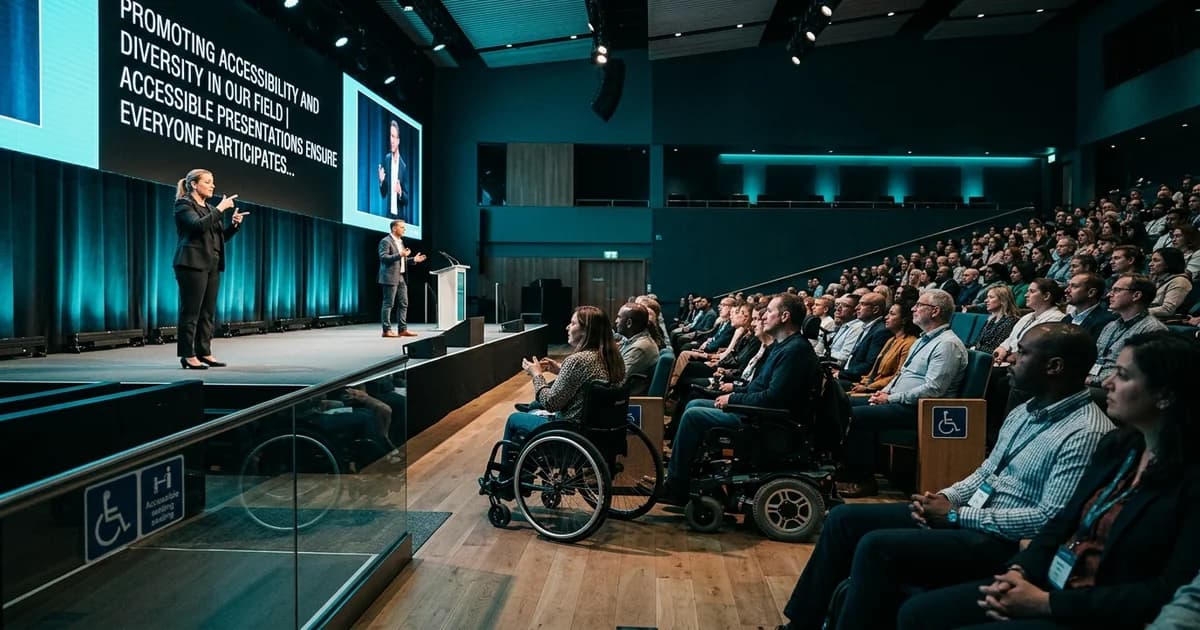
Let's be honest. The European Accessibility Act has felt like a vague, distant deadline for a long time. But now it's right around the corner.
The deadline is June 28, 2025. And it's not just a suggestion. It’s a legal requirement for anyone organising events for a European audience, even if your company is based in the US or UK. So, what does this actually mean for your conference, your trade show, or your all-hands meeting? It means accessibility isn't a "nice-to-have" anymore. It’s a must-have. This is especially true when it comes to language. Providing robust event accessibility interpretation and captioning isn't just about reaching a wider audience—it's about compliance.
But this isn't another doom-and-gloom compliance article. This is a practical guide. We'll break down exactly what the EAA is, how it impacts your events, and how you can use tools like live interpretation and captions to not only comply, but to create genuinely better, more inclusive experiences for everyone.
And honestly, that’s the biggest issue. Better accessibility makes for better events. Period.
What Is the European Accessibility Act (EAA)?
Think of the EAA as a set of common rules for the entire EU market. Its goal is simple: to make sure products and services are accessible to the 1.3 billion people globally who experience a significant disability. Before the EAA, accessibility laws were a patchwork across different EU countries. Now, there’s one standard.
The Act covers a lot of ground, from computers and smartphones to banking services and e-commerce. For you, the most important part is that it applies to services, which includes:
- Websites and mobile apps (like your event registration page).
- E-commerce platforms (how you sell tickets).
- Access to audiovisual media services (your event's live and on-demand content).
- Communications services (the actual experience during your virtual or hybrid event).
The technical standard it points to is, for the most part, the Web Content Accessibility Guidelines (WCAG) 2.1 Level AA. If you've ever dealt with website accessibility, you've probably heard of WCAG. It’s built on four principles: content must be Perceivable, Operable, Understandable, and Robust.
So, if you sell tickets, host content, or provide a digital event experience to people in the EU, the EAA applies to you.
How the EAA Affects Events and Conferences
This is where the theory hits the road. The EAA doesn't just live on your website; it extends to the entire event experience, especially for hybrid and virtual formats.
1. Digital Touchpoints Must Be Accessible
Every digital part of your event has to be compliant. This isn't just your main event website. It's everything.
- Registration Pages: Can a screen reader easily navigate your ticket purchase form? Are form fields clearly labeled?
- Event Apps & Platforms: If you use an event app, can people navigate it without a mouse? Does it have high-contrast text options?
- Promotional Materials: Are the PDFs of your agenda accessible? Is the text in your marketing emails readable by assistive tech?
2. Live and On-Demand Content is a "Service"
Here's the big one for language. For attendees who are deaf or hard of hearing, spoken content without text is an immediate barrier. The EAA's principles require you to provide alternatives. This means:
- Live Sessions: Real-time spoken content must be made accessible.
- Video Recordings: Any videos you post after the event need captions.
This is where many organisers get stuck. How do you make a live, unscripted panel discussion accessible to someone who can't hear it? Or to someone who doesn't speak the presenter's language?
That's the exact problem that event accessibility interpretation and captioning solve.
Live Captions and Interpretation as EAA Compliance Tools
Language access is a cornerstone of true accessibility. Offering captions and interpretation isn't just a feature; it's how you make your event perceivable and understandable for more people.
Let’s break down the two key tools.
Live Captions (or Subtitles)
These are real-time, text-based transcriptions of everything being said. Think of the subtitles you turn on for a movie. For someone who is deaf or hard of hearing, they aren't optional—they are the only way to access the content. For EAA purposes, auto-generated captions can be a starting point, but their accuracy can be an issue, especially with technical content or multiple speakers. A solution that provides high-accuracy, real-time captions is a direct way to meet this need.
Live Interpretation (or Remote Simultaneous Interpretation - RSI)
Interpretation goes a step further. It doesn’t just transcribe; it translates. A live interpreter (or in some cases, an AI engine) listens to the speaker in one language and relays it in another.
This addresses two major accessibility hurdles:
- Hearing Impairment: Some platforms can provide a live transcript of the interpretation, giving a text-based version in the attendee's language.
- Language Barriers: For an international audience, this is critical. An attendee from Germany can listen to an English keynote in German, in real-time.
Modern RSI platforms have completely changed the game here. You don't need clunky hardware or soundproof booths anymore. You can add 20+ languages to your event with a software-based solution that's ready to go in minutes. It's time to find a partner who can help you Check EAA Compliance.
EAA 2025 Compliance Checklist for Event Organisers
Feeling overwhelmed? Don't be. Here's a practical checklist to get you started.
Phase 1: Your Digital Front Door
- [ ] Audit Your Website & Registration: Use a tool to check for WCAG 2.1 AA compliance. Can you navigate and buy a ticket using only your keyboard?
- [ ] Accessible Communication: Ensure promotional materials are accessible. Use high-contrast colors and provide alt-text for images in emails and on social media.
- [ ] State Your Accessibility: Add an accessibility statement to your website. Tell people what you offer (e.g., live captions, ASL interpretation) and give them a contact person for requests.
Phase 2: The Live Event Experience
- [ ] Budget for Accessibility: Earmark 5-10% of your budget specifically for accessibility measures like interpretation, captioning, or sign language interpreters.
- [ ] Plan for Language Access: Decide on your language support strategy. Will you offer live captions for all sessions? Will you need live interpretation for keynotes?
- [ ] Choose an Accessible Platform: If your event is virtual or hybrid, does your platform support integrated interpretation and captions? Can attendees easily access these features?
- [ ] Onsite Venue Check: For in-person events, confirm the venue has accessible routes, restrooms, and seating. This is a foundational part of accessibility.
Phase 3: Technology and Execution
- [ ] Select Your Interpretation Partner: Find an EAA compliance interpretation solution. Do they require app downloads, or can attendees access it easily via a QR code? How long does setup take?
- [ ] In-Platform vs. Integrated: Can your interpretation solution plug directly into Zoom, Teams, or whatever platform you already use? This avoids forcing attendees to juggle multiple windows.
- [ ] Train Your Speakers & Staff: Remind speakers to describe visual content on their slides. Make sure your staff knows how to direct attendees to access interpretation or captioning.
How InterpretWise Helps You Meet EAA Requirements
Okay, so you need a simple, scalable way to handle the language part of EAA compliance. That's exactly why we built InterpretWise.
We saw the old way of doing things—booths, tons of hardware, 8-hour setups, and sky-high costs—and knew there had to be a better way.
InterpretWise is a real-time multilingual interpretation platform that's designed for today's events. We help you offer the language accessibility that the EAA demands, but without the traditional headaches.
Here’s how we're different:
| Feature | Traditional / Other RSI Platforms | InterpretWise Solution |
|---|---|---|
| Setup | Hardware booths, 4-8 hour setup | Software-only, 15-30 min setup |
| Attendee Access | Clunky headsets, required app downloads | Simple QR code scan on their own phone—no app needed |
| Technology | Often human-only, or AI-only | Hybrid AI + human interpreters for the best balance of cost and accuracy |
| Captions | Often a separate service/cost | Live subtitles and captions are included |
| Integrations | Limited, or requires complex API work | Integrates directly with Zoom, Teams, Google Meet, Webex, and more |
| Pricing | Complex, often requires enterprise contracts | Significantly more affordable, scales from 20 to 5,000+ people |
Instead of worrying about hardware and logistics, you can focus on your event. You get a dedicated event manager, we integrate with the platform you're already using, and attendees get instant access to over 20 languages simultaneously. It's the most straightforward way to provide event accessibility interpretation and get peace of mind.
Ready to see how simple compliance can be? Let's Check EAA Compliance together.
Frequently Asked Questions (FAQs)
1. What's the difference between live captions and live interpretation for EAA?
Live captions are a text version of the audio in the same language, essential for those who are deaf or hard of hearing. Live interpretation translates the audio into a different language, making it accessible for international attendees. Both are powerful tools for meeting EAA's "perceivable and understandable" principles.
2. Do I need human interpreters for EAA compliance, or is AI enough?
The EAA doesn't specify. AI interpretation is great for accessibility at scale and is significantly cheaper. However, for high-stakes content like legal or medical conferences, many organisers prefer the nuance of a human interpreter. InterpretWise offers a hybrid model so you can choose the best fit for each session.
3. How much does event accessibility interpretation cost for a conference?
It varies widely. Traditional booth-and-hardware setups can cost tens of thousands of euros. Modern RSI platforms are much more affordable. InterpretWise's pricing is based on your needs and event size, but it's designed to be a fraction of the cost of old-school solutions.
4. Our event uses Zoom/Teams; can we add compliant interpretation?
Yes. Modern interpretation platforms are built for this. InterpretWise integrates directly into Zoom, Microsoft Teams, Google Meet, and Webex, so the interpretation and captions appear right within the meeting platform your attendees are already using.
5. How do attendees access interpretation without downloading an app?
This is a key differentiator for user-friendly platforms. With InterpretWise, attendees simply scan a QR code with their smartphone. This opens a web page on their browser where they can select their language and listen with their own headphones. It's instant and avoids the friction of the app store.
Related Articles
Live Subtitles for Events: The Complete Guide (2026)
Language Access as a Pillar of DEI: Building an Inclusive Corporate Event Strategy
Maximizing Impact: A Guide to Cost-Effective Interpretation for NGOs and Non-Profits
Live Captions and WCAG 2.2: A Guide to Making Your Events Accessible and Compliant

Developing a Corporate Language Access Policy: A Framework for Global Companies
InterpretWise for European Institutions: GDPR Compliance and EU-Focused Solutions