

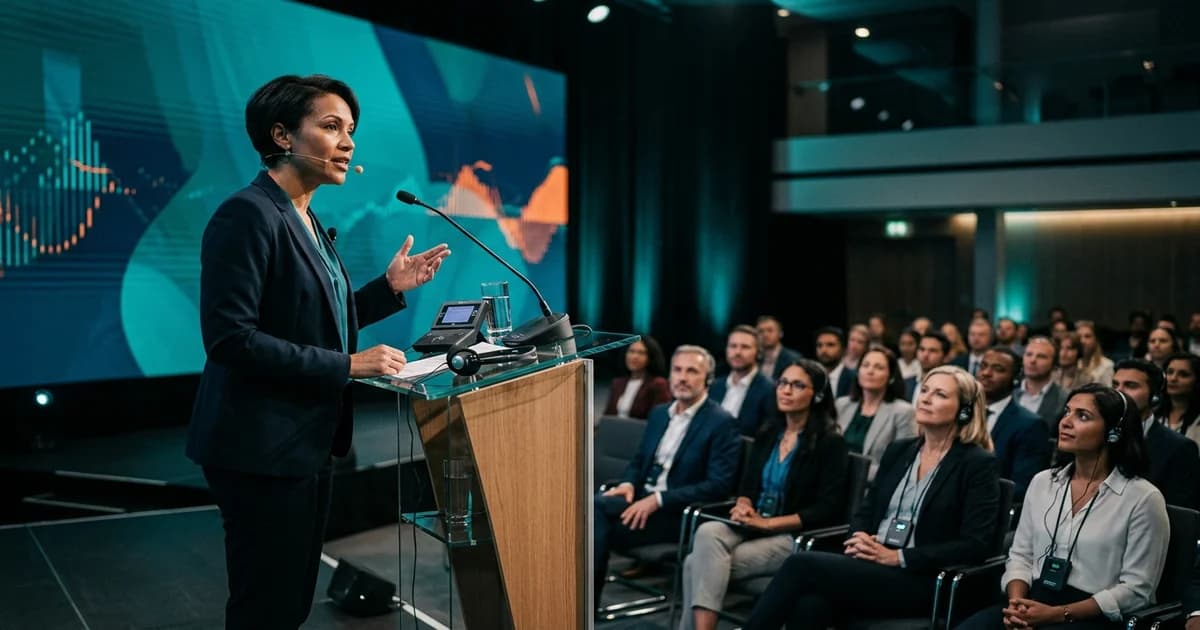
You’ve crafted the perfect message. Your slides are sharp, your data is compelling, and you’re ready to share your expertise. But this time, your audience is global, and they'll be listening through the voice of an interpreter. Are you ready for that?
Presenting at a multilingual event isn't just about what you say—it's about how you say it so your message can be accurately reborn in another language. Think of the interpreter as your partner in communication. Your delivery is the raw material they have to work with, and the better the material, the better the final product.
The demand for multilingual experiences is higher than ever. With hybrid events now the norm, audiences expect to understand and engage, no matter their language. For you, the speaker, this creates an incredible opportunity to expand your reach. But it also means adapting your style. Don't worry, it's easier than you think. This guide will walk you through everything you need to know, from pre-event prep to handling a live Q&A like a pro.
Why Your Delivery Directly Affects Interpretation Quality
Ever had a bad phone connection where you only catch every other word? The person on the other end is speaking clearly, but the technology is failing. The result? A garbled, incomplete message. The same thing happens when a speaker’s delivery isn't optimized for interpretation.
Simultaneous interpretation is an act of intense cognitive multitasking. The interpreter is listening to your words, analyzing the meaning, mentally translating it, and speaking the new version—all while you're already moving on to your next sentence.
When a speaker talks too fast, uses dense jargon, or tells a culturally specific joke, it's like adding static to the line. The interpreter might miss a key detail, the translation might lose its nuance, or worse, the core message could be distorted. Reddit forums are filled with stories of presentations gone wrong—not because of bad interpreters, but because the speaker's delivery made the interpreter's job impossible, leaving the audience confused. Your clarity, pace, and preparation are the difference between a message that resonates globally and one that falls flat.
Before the Event: Share Your Materials with the Interpreter
This is the single most important thing you can do to ensure a successful multilingual presentation. Sharing your materials isn't about the interpreter pre-judging your talk; it's about letting them do their homework. Remember, they are your partner. Equip them to succeed.
Professional interpreters don't just translate words; they convey meaning. By providing your presentation slides, a script, or even just a detailed outline ahead of time, you give them context. They can research specific terminology, understand the flow of your argument, and get familiar with proper nouns, acronyms, and any specialized vocabulary. This is especially critical for highly technical fields like medicine, finance, or engineering.
We've seen how much smoother events run when speakers and interpreters are prepared. With a platform like InterpretWise, you can easily share documents with your assigned interpreters right in the browser-based system, ensuring they have everything they need well before the event starts. It’s a simple step that removes a massive amount of potential friction.
What to share:
- Your slide deck: Even if it’s mostly images, it shows the structure.
- A script or detailed outline: This is the gold standard.
- A glossary of terms: Include acronyms, technical jargon, and any non-standard vocabulary.
- Links to any videos you'll play: This allows the interpreter to preview them.
Speaking Pace for Simultaneous Interpretation: How Fast Is Too Fast?
If you're a naturally fast talker, you'll need to make a conscious effort to slow down. But how fast is too fast? While there isn't a magic number, a good rule of thumb is to aim for a clear, deliberate pace of around 120 words per minute. For reference, a typical conversational pace is closer to 150-160 wpm.
Think of it as adding intentional pauses. When you complete a key idea or finish a complex slide, take a breath. Let the point land. These brief moments of silence are golden for an interpreter. They provide a crucial buffer to process the information accurately and deliver a high-quality translation without rushing.
Don't mistake this for a rigid, unnatural delivery. It’s not about speaking like a robot. It’s about being deliberate. You're not waiting for the interpreter to finish (that’s consecutive interpretation); you're simply building space into your natural rhythm. This measured pace not only helps the interpreter but also makes your presentation more powerful and easier for everyone to digest.
Clarity Over Complexity: Avoiding Idioms, Jargon, and Acronyms
You might want to "hit a home run" with your presentation, but for a global audience, that phrase will likely cause more confusion than inspiration. Idioms, colloquialisms, and sports metaphors are deeply tied to a specific culture and rarely translate directly.
Your goal is clarity. Opt for straightforward language.
- Instead of: "We need to think outside the box."
- Try: "We need to consider creative and unconventional ideas."
- Instead of: "Let's not bite off more than we can chew."
- Try: "Let's be realistic about what we can accomplish with our current resources."
The same rule applies to jargon and acronyms. While it might be tempting to use industry-specific shorthand, you risk alienating a portion of your audience—and your interpreter. If you absolutely must use a technical term or an acronym, do two things:
- Provide it in your pre-event glossary.
- Briefly explain it the first time you use it.
This simple habit ensures everyone stays on the same page.
How to Work with Your Slides in a Multilingual Presentation
Your slides are a visual anchor for the entire audience. In a multilingual setting, they take on even greater importance. Here are a few best practices for presenting with slides and an interpreter:
- Keep slides text-light. Use them to reinforce your key ideas with visuals, data charts, and minimal text. This prevents the audience from trying to read a dense slide in one language while listening to the interpretation in another.
- Avoid reading your slides aloud. The interpreter is already translating what you say. If you simply read what's on the screen, it creates a disorienting echo. Paraphrase the content on the slide and add your own insights.
- Pause after advancing a slide. Give the audience—and the interpreter—a moment to absorb the new visual before you start speaking again. A two-second pause is all it takes.
And because you're presenting to a global audience, make sure your visuals are culturally neutral. Avoid images, memes, or symbols that might be misunderstood or offensive in other cultures.
How to Handle Live Q&A in a Multilingual Setting
The Q&A session is where your audience engagement really comes to life. With interpretation, it requires a bit of management to keep it running smoothly.
First, the technology needs to be right. For a hybrid or in-person event, ensure there are microphones available for audience members. The interpreter can only translate what they can hear. This is where a fully integrated platform shines. With a system like InterpretWise, attendees can access the interpretation on their own phones via a simple QR code, and virtual attendees are seamlessly integrated. This means everyone can hear the original question and the interpretation clearly.
Here’s a simple process for moderated Q&A:
- Wait for the full question. Let the audience member finish speaking before you begin to formulate your answer.
- Allow the interpreter to finish. The interpreter will translate the full question for you and the rest of the audience.
- Give your answer. Keep your answer concise and to the point. Avoid answering multiple questions at once.
- Pause. Allow the interpreter to translate your full answer for the audience.
It’s a turn-based conversation, and a little patience goes a long way. This structure ensures that everyone participates in the same conversation, regardless of their language.
Pre-Event Checklist for Speakers
Feeling ready? Run through this final checklist before you go live.
- [ ] Materials Sent: Have you sent your slides, script, and glossary to the event organizer or interpreter at least 48 hours in advance?
- [ ] Tech Check: Have you tested your microphone and connection? If the event is virtual, do you have a stable internet connection and good lighting?
- [ ] Meet the Interpreter (If Possible): Have you had a brief pre-session chat with the interpreter to review key terms or pronunciation?
- [ ] Pacing Plan: Do you have a mental or physical note (e.g., a sticky note on your monitor) to remind yourself to speak at a measured pace?
- [ ] Water Ready: Is there a glass of water nearby? Staying hydrated is key for vocal clarity.
- [ ] Q&A Plan: Do you know how the Q&A will be moderated?
- [ ] Direct Your Gaze: Remember to speak and make eye contact with your audience, not the interpreter. They are the channel, but your audience is the destination.
Presenting at a multilingual event is a skill. And like any skill, it gets easier with practice. By following these guidelines, you're not just making the interpreter's job easier—you're ensuring your message is heard, understood, and respected across cultures. You're showing your global audience that you value their participation. And that is the foundation of truly effective communication.
Ready to see how simple it is to make your next event globally accessible? See How It Works.
Frequently Asked Questions (FAQ)
PAA: How fast should you speak for an interpreter?
You should aim for a clear, measured pace of about 120 words per minute. This is slightly slower than a typical conversational speed. More importantly, incorporate brief pauses between key points to give the interpreter time to process and accurately convey your message.
PAA: Do you have to pause for an interpreter?
In simultaneous interpretation, you don't need to pause after every sentence. However, you should build in natural pauses of a few seconds after completing a main idea or a complex thought. This gives the interpreter a chance to catch up and ensures the translation is accurate and complete, rather than rushed.
PAA: Should you make eye contact with the interpreter or the audience?
Always make eye contact with and speak directly to your audience. Think of the interpreter as your voice, not the person you're having a conversation with. Focusing on the audience builds rapport and creates a more engaging experience for them. The interpreter is a professional facilitator whose job is to be as unobtrusive as possible.
PAA: How do you prepare for a presentation with an interpreter?
The best preparation involves three key steps. First, provide your interpreter with all your presentation materials—slides, scripts, glossaries—well in advance. Second, practice your presentation with a focus on speaking clearly and at a moderate pace, avoiding idioms or overly complex jargon. Finally, if possible, have a brief pre-event meeting with the interpreter to clarify any specific terminology or pronunciations.
Related Articles
Live Subtitles for Events: The Complete Guide (2026)
What Is Remote Simultaneous Interpretation (RSI)? The 2026 Guide

Simultaneous vs. Consecutive Interpretation: Which to Choose for Your Event?
Beyond the Basics: How to Run a Truly Inclusive Multilingual Town Hall
From Geneva to Your Screen: Lessons from the UN Interpretation Process
Engage Everyone: A Practical Guide to Managing Multilingual Q&A Sessions