

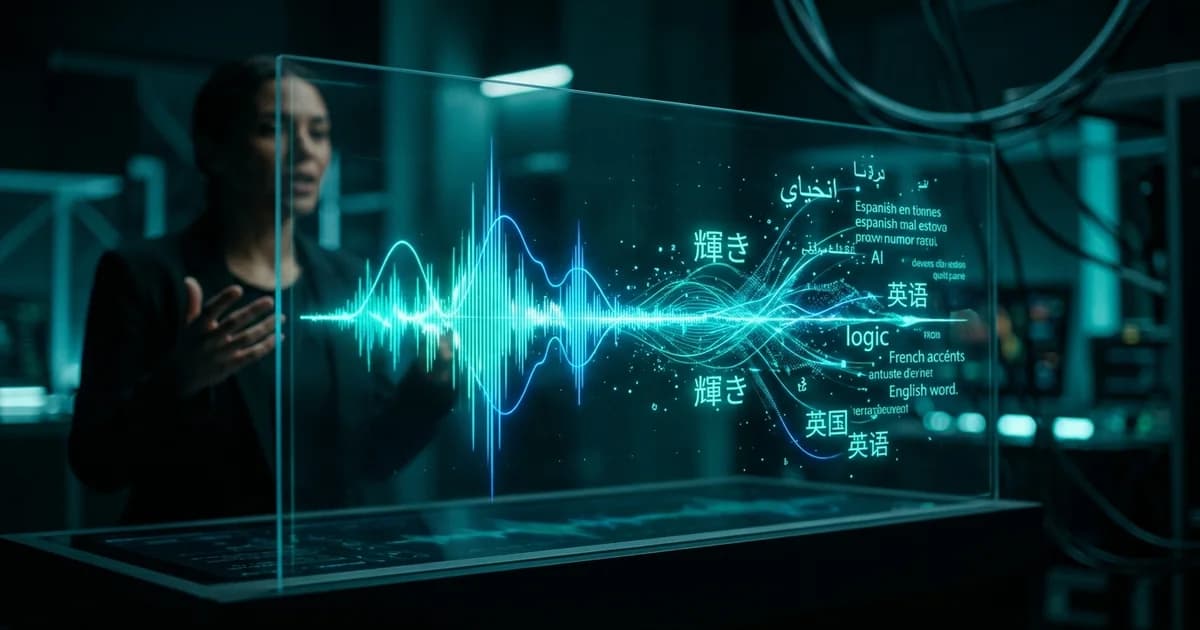
You’ve seen it everywhere. From your phone suggesting the next word in your text to the captions popping up on a live video, artificial intelligence is deeply woven into our daily communication. And now, it's making a serious mark on live events. For event organizers, the promise of instant, multilingual communication through AI is massive. But what's the reality?
As we look at the landscape in 2026, the conversation has moved beyond a simple "AI vs. human" debate. It's more nuanced, more interesting, and frankly, more practical than ever before. This isn't about a futuristic takeover; it's about understanding the tools available today and how to use them smartly. We're talking about a shift from seeing AI as a replacement to seeing it as a powerful collaborator. Let's break down where AI interpretation stands in 2026, what accuracy really means, and how you can make it work for your events.
How AI Interpretation Models Have Evolved: A 2026 Snapshot
The journey of AI interpretation has been one of rapid acceleration. Just a few years ago, machine translation was often clunky, literal, and a source of amusement. Now, things are different.
The big leap came with the move from older statistical methods to Neural Machine Translation (NMT), and more recently, the integration of Large Language Models (LLMs). Instead of translating word-for-word, these systems process whole sentences, giving them a much better grasp of context, grammar, and flow. Think of it as the difference between a phrasebook and a fluent speaker; one gives you the parts, the other delivers the meaning.
By 2026, the technology is no longer just about translation; it's about multilingual content generation. AI models can now produce high-quality first drafts, localize user interface copy, and even generate marketing slogans in different languages. This is powered by a combination of a few key technologies:
- Automatic Speech Recognition (ASR): This is what turns spoken words into text. Its accuracy has improved dramatically, even with different accents and background noise.
- Natural Language Processing (NLP): This helps the machine understand the meaning and structure of the text from ASR.
- Neural Machine Translation (NMT): This is the core engine that translates the understood text into another language.
The result is end-to-end, real-time speech-to-speech translation that's becoming a feasible option for meetings and events. The global AI translation market is a testament to this growth, projected to have reached $12.3 billion by 2027 based on 2024 projections. But as we'll see, raw numbers don't tell the whole story.
Understanding 'Accuracy': Beyond Word-for-Word Translation
Here’s the number one question on every event organizer’s mind: "How accurate is it?"
It's a simple question with a complex answer. Even in 2026, the most advanced AI interpreting systems hover around 82-88% accuracy. In contrast, certified human interpreters consistently achieve 98-99% accuracy. That 10-15% gap is where the most critical information lives—nuance, cultural context, idioms, and speaker intent.
Accuracy isn't just about getting the words right; it's about getting the meaning right. AI can struggle with:
- Idioms and Slang: A phrase like "break a leg" can be disastrously misinterpreted by a literal-minded AI.
- Cultural Nuance: Humor, sarcasm, and politeness are expressed differently across cultures. A human interpreter instinctively adapts; an AI often doesn't. Up to 47% of contextual meaning can be lost in machine translation.
- High-Stakes Terminology: In legal, medical, or technical fields, a single incorrect word can have major consequences. A mistranslated dosage instruction or a misunderstood contract clause isn't just an error—it's a serious risk.
This is why, in 2026, we see a clear trend: the higher the stakes, the more crucial the human element. For a low-risk, informational webinar, AI-powered captions might be perfect. For a sensitive diplomatic negotiation or a complex medical conference, you need the reliability and contextual awareness a human interpreter provides.
The Rise of Hybrid Models: Where AI Supports Human Interpreters
So, if AI isn't perfect and humans are the gold standard for quality, where does that leave us? It leads us to the most practical and powerful trend in 2026: the hybrid model.
This isn’t about AI replacing humans, but augmenting them. It’s a collaboration that leverages the best of both worlds. AI provides the speed and scale, while humans provide the nuance, empathy, and quality assurance.
Think about it in practice at your own events. You could use an AI-driven platform that offers both automated interpretation for certain sessions and the ability to bring in professional human interpreters for others. This gives you incredible flexibility.
- For large-scale breakouts or general sessions: Use AI-powered live captions in 20+ languages. This makes the content accessible to a massive audience without the logistical complexity of coordinating dozens of interpreters.
- For your VIP-only Q&A or a high-stakes technical deep-dive: Switch to professional human interpreters for that session. You ensure the highest level of accuracy and nuance precisely when it matters most.
This hybrid approach is already shaping the future. Research from 2025 showed that 83% of organizations using AI interpreting still required human validation for accuracy. It’s a model built on AI efficiency balanced with human oversight. And platforms that are 100% browser-based make it seamless to switch between these modes without needing any special hardware or app downloads for attendees.
What's Next? Generative AI, Contextual Awareness, and Custom Vocabularies
The field is not standing still. The next wave of AI interpretation is focused on closing that accuracy gap by becoming more, well, human-like.
Generative AI is leading this charge. Instead of just translating, generative models can summarize, explain, and adapt content in real-time. Imagine an AI that doesn't just provide a word-for-word interpretation of a complex speech but can also generate a concise summary in three bullet points for attendees who joined late.
Semantic understanding is another key frontier. This is the AI’s ability to grasp the underlying meaning and intent, not just the literal words. For example, it would know that "I'm running for office" is different from "I'm running to the office." This is crucial for improving reliability in specialized fields like healthcare and technology.
Finally, custom vocabularies are becoming a standard feature. Leading platforms allow you to upload a glossary of terms specific to your company or event—think brand names, technical jargon, or acronyms. The AI is then pre-trained on this vocabulary, dramatically improving its accuracy for your specific content. This simple step moves the needle from generic translation to a more tailored, relevant experience.
How Event Organisers Can Realistically Leverage AI Interpretation Today
The future is exciting, but you have events to run now. How can you use this technology realistically in 2026?
The key is to match the tool to the task. Don't think of it as an all-or-nothing choice.
- Start with Accessibility: The easiest and most immediate win is using AI for live captions. It's a massive boost for inclusivity, helping non-native speakers, the hard-of-hearing, and anyone in a noisy environment. Platforms that include live captions with their interpretation services make this a no-brainer.
- Embrace the Hybrid Model: Look for a platform that gives you options. Can you have AI interpretation for your main stage and human interpreters for a sensitive breakout room? A flexible, browser-based solution that doesn't require hardware makes this incredibly easy to implement. Attendees can simply scan a QR code to access the audio channel they need.
- Define Your Needs: Ask yourself: what is the risk level of this communication? For a casual company all-hands, AI might be perfectly sufficient. For a legally binding contract discussion, you need a human. Being honest about this will guide your strategy.
- Focus on the Attendee Experience: The best technology feels invisible. The goal is to make your content accessible to everyone, regardless of the language they speak. A solution that works directly in their browser—no app download required—removes a major friction point and boosts adoption.
The technology has evolved to a point where setting up multilingual interpretation for an event can take as little as 15-30 minutes. It integrates with the platforms you already use, like Zoom, Teams, and YouTube Live, and can scale from an intimate meeting of 20 to a global conference of 5,000. It's about finding a solution that offers this power and flexibility. If you're curious to see how straightforward it can be, it’s worth taking a look to See How It Works.
FAQs: The Future of AI in Live Interpretation
How accurate will AI translation be in 2026?
In 2026, AI translation has become remarkably fluent, but accuracy depends on the context. For general topics, top-tier AI models achieve 82-88% accuracy. However, they still lag behind professional human interpreters, who reach 98-99% accuracy. The gap is most noticeable with complex subjects, idioms, and cultural nuance.
Can AI replace human interpreters?
Not in high-stakes situations. While AI is a powerful tool for low-risk content and increasing accessibility, it cannot replace the cultural understanding, ethical judgment, and contextual awareness of a human interpreter. The future is collaborative, with hybrid models using AI for scale and humans for critical accuracy.
What is the future of AI interpretation?
The future is smarter, more integrated, and more collaborative. We're seeing the rise of generative AI that can summarize content, semantic models that understand intent, and greater personalization. The focus is shifting from simple word-for-word translation to a more holistic understanding of communication, often in a hybrid AI-human framework.
What are the limitations of AI in interpretation?
The main limitations are a lack of true contextual and cultural understanding, difficulty with sarcasm or humor, and potential inaccuracies in specialized fields like law and medicine. Even with custom glossaries, AI can miss the subtle intent that a human interpreter catches instinctively. Data privacy and security can also be concerns if the platform isn't properly vetted.
Related Articles

AI vs Human Interpretation: Which Is Right for Your Event?
Live Subtitles for Events: The Complete Guide (2026)

Conference Interpretation Cost: A Complete 2026 Pricing Breakdown

How to Choose an Interpretation Service: 10 Critical Questions
Live Captions and WCAG 2.2: A Guide to Making Your Events Accessible and Compliant
The Interpreter Shortage: How Technology Can Bridge the Gap for Event Organizers

How to Integrate Browser-Based Interpretation Into Your Event Tech Stack