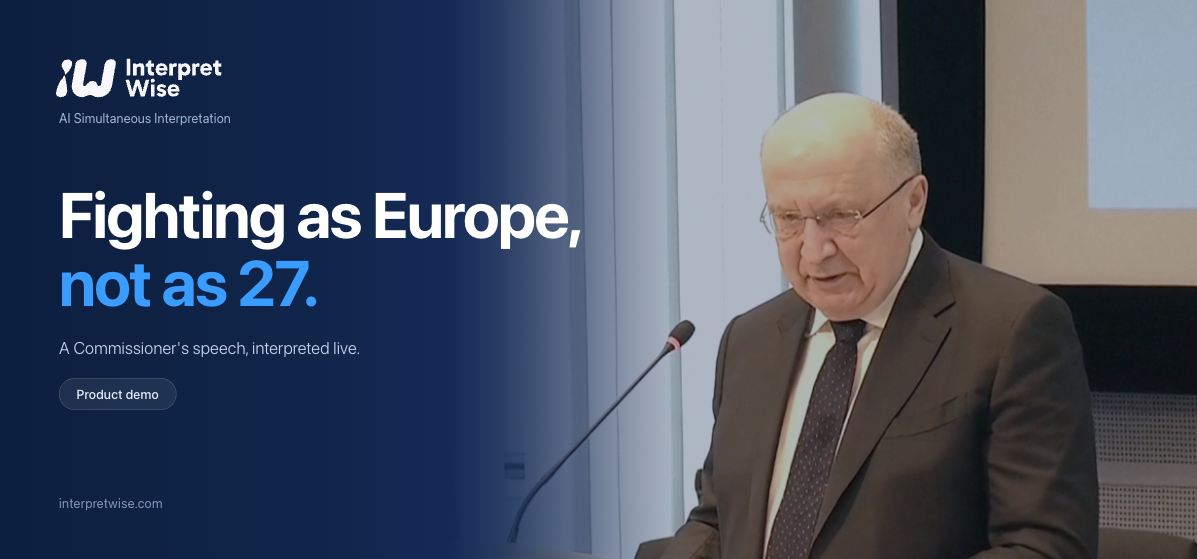
Heli ja subtiitrid, taasesitatud täpselt nii, nagu need otse jooksid
Powered by
Vali keel, et taasesitust alustada
AI tõlge · Taasesitus
Subtiitrid ilmuvad siia taasesituse ajal
Kuupäeval 2026-09-12 salvestatud reaalajas sessiooni toimetamata väljund: saaliheli transkriptsioon on see, mille kõnetuvastaja tootis, ja iga keel on see, mida kuulajad kuulsid, esitatuna AI häälega samal ajal, kui kõneleja rääkis. Ajatemplid on taasesituse asukohad. Ava Markdown vormingus
| Keel | Kõnelejast maas (mediaan) | 90. protsentiil | Pärast kõneleja lõpetamist (mediaan) |
|---|---|---|---|
| Lietuvių | 7.1 s | 8.1 s | 2.6 s |
| Deutsch | 7.5 s | 8.6 s | 2.9 s |
| Français | 7.8 s | 10.1 s | 3.8 s |
Alates hetkest, mil kõneleja alustab (või lõpetab) lauset, kuni hetkeni, mil tõlgitud hääl algab, mõõdetuna serveris. Lisage umbes 0.25 s, et heli jõuaks kuulaja telefonini.
00:10Dear director general, dear Alberto, dear colleagues,
00:18well, first of all, let me say that, as
00:22still young but experienced politician, I'm
00:27excited to see so many lawyers, you know, in one room.
00:34I I was trying to
00:37to remember if I had any time, you know, in previous capacities,
00:42in national politics to see so many lawyers, really, it's
00:44it's it's something. You know?
00:46And
00:51usually, you know, we politicians and lawyers
00:56sometimes we have different opinion about
00:57what is possible and what is impossible.
01:00But out from that, you know,
01:04discussion, I think that the progress really is coming.
01:08So it's my very special honor to open this conference
01:12on the topic towards a genuine European Defense Union
01:17the legal landscape of EU defense policy.
01:23And I would remind that in my mission letter, development of
01:27genuine European defense union is one of the key tasks
01:30So let me begin with some kind of personal confession.
01:35And the confession is this: In January, I published a substantial paper on defense.
01:39And I focused on the deficit of institutional defense readiness,
01:46besides material defense readiness, the absence of effective platforms
01:49for unified political leadership in defense.
01:51And I proposed an European
01:53Security Council format. I stand by that, by what I argued then.
02:01But I need to confess that at that time,
02:04I saw that it was just me and maybe a limited number of others
02:07who were concerned about the institutional side of defense.
02:14That is why I was sincerely surprised
02:17by what Commission President of Underland
02:17recently said.
02:17The Commission President in a very deep
02:25strategic way showed her understanding of the major challenges for our times
02:28when she spoke at the recent ambassador's conference.
02:34And I quote, We urgently need to reflect on whether our doctrine
02:38our institutions, and our decision making
02:42all designing a postwar world of stability and multilateralism,
02:44we have kept pace with the speed of change around us.
02:50Was it a system that we built with all its
02:51well intentioned attempts at consensus and compromise
02:58is more a help or a hindrance to our credibility
03:00as a geopolitical actor. End of quote.
03:04She spoke about institutional deficit in European foreign policy.
03:10But in my view the same applies not only to our foreign policy, but also to our defense policy.
03:18Our defense doctrine, defense institutions,
03:21and our decision making in defense all designed in a possible world of stability
03:24and multilateralism with prevailing intentions of compromise and consensus.
03:31All the existing legal and constitutional constructs
03:31for European defense, and we find them in the Treaty
03:34of the European Union, are they more a help
03:41hindrance for our need to be ready to fight as Europe
03:44not just a combination of twenty seven.
03:44That question became even more acute
03:51after United States under secretary of war for policy, Albert Scholby,
03:53in February told Allied Ministers in Brussels
04:00what he described as a post Cold War NATO two zero
04:03is no longer fit for purpose. He said, we need a NATO three zero.
04:10And Europe should take over the preponderance
04:11of the forces required to deter.
04:13Europe should take primary responsibility
04:14to defeat conventional aggression in Europe.
04:21And in March, NATO's Supreme Allied Commander Europe
04:22General Alexus Grinkiewicz stated to the U. S.
04:22Senate
04:29that the American command in Europe, US EU COM,
04:33is, I quote, prudently and expeditiously
04:37transferring primary responsibility for Europe's conventional defense
04:40to European allies.
04:42So Americans will stay in
04:45secondary role like they are doing now in Ukraine.
04:51For all to hear and to read, he described a deliberate shift
04:53from U.
04:55S.-centric model to a European centric model
04:57in European defense.
04:57Whether one welcomes this language or not,
04:59we should make no mistake.
05:04This is not rhetoric alone. This is a planning and this is real.
05:11In this context, your conference title
05:13could not be more timely and called for.
05:17We know where we want to arrive at a genuine European Defense Union.
05:22The big question, where still we need to find an answer, is also clear.
05:27As existing legal landscape, existing treaties and institutions,
05:34built on the basis of those treaties, existing decision
05:35making growth according to the existing treaties.
05:37Are they more a help
05:41or a hindrance for European defense in new circumstances
05:43when we need to be ready to take into our hands the responsibility for European defense.
05:46To be ready to fight as United Europe
05:48not just as a combination of twenty seven.
05:54That is why I have more questions for this conference than answers.
05:56But as but as somebody once said,
06:02formulation of good questions is half the job.
06:06And it's good that you are here.
06:08Members of legal community.
06:08You can do the other half of the job,
06:15help to answer the questions. It's all about teamwork.
06:22Until now, the Treaty on Union on European Union
06:24got a very clear legal definition, at least how, I am.
06:28Understanding that.
06:30National security remains a sole responsibility of each member state.
06:38Common security and defense policy as it is defined in the treaty
06:41is more for external actions.
06:43Territorial defense is
06:44provided by NATO coordination, but not by the European Union.
06:51In territorial defense of member states, the European Union only
06:55provides the obligation of mutual assistance
06:56in the case of military aggression, the famous forty two-seven article.
07:04So the first question, with the NATO three zero concept,
07:08territorial collective defense in Europe moves
07:09from transatlantic collective defense to more of European collective defense.
07:17Is a treaty on European Union fit for such a
07:18collective European defense?
07:18Article forty two-two
07:26is about common defense and common security and defense policy
07:27or about common territorial defense of Europe.
07:33Second question, according to the treaty on the European Union, defense is a national prerogative.
07:37The outcome of such a historical legacy
07:42is total industrial fragmentation.
07:44Mario Draghi report was very much of
07:47outspoken. The question is how to overcome this.
07:51Can only a bottom up approach, as till now, based on the national defense prerogative
07:56resolve this challenge?
07:56Or can we have a united political leadership
08:03European defense and a top down approach
08:04in order to overcome fragmentation.
08:06Is the treaty on European Union
08:10for that?
08:12Third question, in Munich this year
08:16during Munich Security Forum, Chancellor Friedrich Mertz spoke about the European pillar of NATO.
08:23He proposed to bill an European pillar of NATO around article forty two seven of the Treaty on European Union.
08:30In that case, which article will be the backbone of European defense?
08:37Article forty two-seven or NATO article five?
08:39Fourth question,
08:42what will Europeans be additionally expected to do to strengthen European pillar of NATO?
08:49If there will be a need to organize NATO headquarters,
08:50Is the treaty on European Union ready for that?
08:55Fifth question.
08:57In order to fill potential gaps in the if American troops station in Europe will be shifted
09:03Indo Pacific.
09:05Europe possibly will need to create an European
09:07Rapid Reaction Force or what somebody calls European Army.
09:10Is the treaty on European Union ready for that?
09:15Sixth question.
09:15If Putin decides to test NATO Article five,
09:23as our military intelligence services publicly
09:26saying that such a possibility is quite realistic.
09:34Some members in that case of the European Union
09:37in the neighborhood of Russia perhaps will face aggression of Russian army
09:38with all its battle tested experience.
09:44Possibility to use millions of drones.
09:46Only the Ukrainian Army has
09:49similar experience. How can we integrate that Ukrainian experience?
09:54With our European defense capabilities?
09:56As you know, politically,
09:57NATO is not available for Ukraine.
09:57European Union membership
10:03well, still complicated.
10:05Is the treaty on European Union ready to solve
10:09this challenge?
10:11And then seventh question,
10:13can an European defense union be a solution for the integration of Ukraine
10:19United Kingdom, and Norway with the defense capabilities of the European Union.
10:27Can we agree that in that case it would be impossible
10:32to squeeze such an European Defense Union into existing treaty
10:36on European Union.
10:38And that is why eighth question,
10:41In that case, would a new intergovernmental treaty on European Defense Union
10:42be the best approach?
10:45As was the case with the Schengen Treaty.
10:53And question number nine, would it be possible in that
10:56case to create an European Security Council as a leadership institution of an European defense union.
11:04With a big E5 countries as permanent members
11:07three rotational members and the leaders of European Union institutions,
11:09among Security Council members.
11:11For collective leadership,
11:16of European Defense Union with democratic majority decision making,
11:17and for swift preparation of most important decisions
11:25as Angela Merkel suggested back in twenty eighteen,
11:28when she spoke about initiative to build European Security Council,
11:33When such prepared decisions
11:36then can be supported by majority of European Defense Union members,
11:39like usually happens with coalition of the willing.
11:42And tenth question, could the new intergovernmental treaty on our European Defense Union be built
11:47on the same principles of Article forty two-seven on mutual assistance?
11:52And the last question, number eleven.
11:54Could this treaty on European Defense Union create provisions
11:57for European military headquarters?
11:59Could the treaty provide for the possibility of
12:04European army and for European common defense stockpiles and for proper
12:06financial arrangements for European defense.
12:13Being conservative in my nature, I'm always ready to defend existing law.
12:17But when we need to defend our territory,
12:23the law needs to provide the right possibilities for European defense.
12:29That we will be ready to fight as Europe not just as a combination of twenty seven.
12:37In short, for our defense readiness, we need also
12:39legal defense readiness. We need you.
12:45And at the end, as commission president Ursula von der Leyen urged us,
12:47let's finally answer the main question.
12:49The present existing
12:53legal and constitutional structure for European defense
12:54as we find it in the treaty on European Union?
12:56Is it more a help
12:57or a hindrance for our need to be ready to fight as Europe?
13:00My sincere answer
13:05today in my view it's not enough for our defense.
13:11That is why I urge the creation of new genuine European Defense Union
13:14which would include also the United Kingdom, Norway, and Ukraine.
13:19And to do that, let's have an additional new intergovernmental treaty.
13:26Let's have the law for the defense of Europe by Europe
13:28and for peace in Europe. Thanks a lot.
00:11Gerbiamas generalinis direktoriau, gerbiamas Alberto, gerbiami kolegos,
00:18visų pirma leiskite pasakyti, kad kaip
00:23dar jaunas, bet patyręs politikas, aš esu
00:28džiaugiuosi matydamas tiek daug teisininkų vienoje patalpoje.
00:35suprasti, kaip galėčiau geriau pasinaudoti jūsų patirtimi.
00:38prisiminiau, ar anksčiau turėjau kokių nors galimybių, žinote, dirbdamas ankstesnėse pareigose,
00:43nacionalinėje politikoje matyti tiek daug teisininkų, iš tiesų tai yra
00:47kažkas ypatingo, žinote?
00:49tai parodo, kaip stipriai teisė ir politika yra susijusios.
00:52paprastai, žinote, mes, politikai ir teisininkai,
00:57kartais turime skirtingą nuomonę apie
00:59tai, kas įmanoma, o kas neįmanoma.
01:01iš to, žinote,
01:05diskusijos manau, kad pažanga tikrai ateina.
01:08Todėl man ypatinga garbė atidaryti šią konferenciją.
01:13tema apie tikrąją Europos gynybos sąjungą.
01:18teisinį ES gynybos politikos kraštovaizdį.
01:24savo misijos laiške priminčiau, kad vystymas
01:28tikros Europos gynybos sąjungos yra viena iš pagrindinių užduočių.
01:32Leiskite pradėti nuo tam tikro asmeninio prisipažinimo.
01:36Prisipažinimas toks: sausio mėnesį paskelbiau išsamų dokumentą apie gynybą.
01:41sutelkiau dėmesį į institucinės gynybos pasirengimo trūkumą,
01:48be to, materialinio gynybos pasirengimo, veiksmingų platformų nebuvimą.
01:52vieningos politinės lyderystės gynybos srityje trūkumą.
01:55Pasiūliau Europos saugumo tarybos formatą. Laikausi to, ką tuomet teigiau.
02:02turiu prisipažinti, kad tuo metu,
02:05mačiau, kad buvau vienas ir galbūt tik nedidelis skaičius kitų,
02:08kurie rūpinosi instituciniais gynybos aspektais.
02:14Todėl buvau nuoširdžiai nustebęs,
02:18kai sužinojau, ką Underlando Komisijos prezidentas
02:21neseniai labai aiškiai pasakė.
02:25strategiškai parodė savo supratimą apie didžiausius mūsų laikų iššūkius.
02:29kai ji kalbėjo neseniai vykusioje ambasadorių konferencijoje.
02:34Skubu cituoti: ar mūsų doktrina
02:39mūsų institucijos ir sprendimų priėmimas
02:42visi kuriantys pokarinį stabilumo ir daugiašališkumo pasaulį,
02:46prisitaikėme prie aplink mus vykstančių pokyčių tempo.
02:51sukūrėme sistemą su visais jos
02:53geranoriškais bandymais pasiekti konsensusą ir kompromisą,
02:59yra labiau pagalba ar kliūtis mūsų patikimumui.
03:02kaip geopolitinis veikėjas. Citatos pabaiga.
03:05Ji kalbėjo apie institucinį deficitą Europos užsienio politikoje.
03:11Tačiau, mano nuomone, tas pats galioja ne tik mūsų užsienio politikai, bet ir gynybos politikai.
03:18mūsų gynybos doktrina, gynybos institucijos,
03:22ir mūsų sprendimų priėmimas gynybos srityje, visa tai sukurta galimo stabilumo pasauliui.
03:27bei multilateralizmu, kuriame vyrauja kompromiso ir konsensuso siekiai.
03:32Visos esamos teisinės ir konstitucinės struktūros,
03:35skirtos Europos gynybai, ir jas randame Sutartyje.
03:38Europos Sąjungos, ar jos labiau padeda,
03:42ar trukdo mūsų poreikiui būti pasiruošusiems kovoti kaip Europa?
03:46ne tik dvidešimt septynių derinys.
03:48Tas klausimas tapo dar aktualesnis.
03:52po to, kai Jungtinių Valstijų karo politikos sekretorius Albertas Scholby,
03:56vasarį Briuselyje pasakė sąjungininkų ministrams,
04:01ką jis apibūdino kaip pokarinį Šaltojo karo NATO 2.0.
04:06nebeatitinka savo paskirties. Jis teigė, kad mums reikia NATO 3.0.
04:10O Europa turėtų perimti didžiąją dalį atsakomybės,
04:13reikalingų pajėgų, kad atgrasytų.
04:16Europa turėtų prisiimti pagrindinę atsakomybę,
04:19už įprastos agresijos Europoje nugalėjimą.
04:22O kovo mėnesį NATO vyriausiasis sąjungininkų vadas Europoje
04:25generolas Alexus Grinkiewicz pareiškė JAV,
04:30kad Amerikos vadovybė Europoje, JAV EU COM,
04:34veikia, cituoju, apdairiai ir sparčiai,
04:38perduodama pagrindinę atsakomybę už Europos įprastinę gynybą,
04:42Europos sąjungininkams.
04:44Europoje, tačiau amerikiečiai liks,
04:46antraeilėje rolėje, kaip jie daro dabar Ukrainoje.
04:52į apgalvotą pokytį, kurį jis apibūdino visiems girdint ir skaitant,
04:55nuo JAV,
04:56į Europą orientuotą modelį.
04:59Europos gynyboje.
05:01nesvarbu, ar kas nors sveikina tokią kalbą, ar ne,
05:04Neturėtume klysti.
05:05Tai nėra vien retorika. Tai yra planavimas ir tikrovė.
05:12Šiame kontekste jūsų konferencijos pavadinimas
05:15yra itin savalaikis ir reikalingas.
05:18Žinome, kur norime pasiekti tikrąją Europos gynybos sąjungą.
05:23Didysis klausimas, į kurį dar turime rasti atsakymą, taip pat yra aiškus.
05:27esama teisinė aplinka, esamos sutartys ir institucijos,
05:35paremtos tomis sutartimis, esamais sprendimais.
05:38priimami sprendimai, augantys pagal esamas sutartis.
05:41Ar jie labiau padeda
05:42ar trukdo Europos gynybai naujomis aplinkybėmis?
05:46kai turime būti pasirengę prisiimti atsakomybę už Europos gynybą.
05:49ir būti pasirengę kovoti kaip vieninga Europa.
05:52ne tik kaip dvidešimt septynių šalių derinys.
05:55Todėl šiai konferencijai turiu daugiau klausimų nei atsakymų.
05:58kaip kažkas kadaise pasakė,
06:03gerų klausimų formulavimas yra pusė darbo.
06:07Gerai, kad esate čia.
06:09Teisinės bendruomenės nariai.
06:11jūs galite atlikti kitą pusę darbo,
06:16padėti atsakyti į klausimus. Viskas priklauso nuo komandinio darbo.
06:23Iki šiol Europos Sąjungos sutartis
06:25turėjo labai aiškų teisinį apibrėžimą, bent jau mano supratimu.
06:29Suprantant tai.
06:31Nacionalinis saugumas išlieka kiekvienos valstybės narės išimtinė atsakomybė.
06:38bendroji saugumo ir gynybos politika, kaip apibrėžta sutartyje,
06:42yra labiau skirta išoriniams veiksmams.
06:45teritorinė gynyba yra
06:47užtikrinama NATO koordinavimu, bet ne Europos Sąjunga.
06:52teritorinėje valstybių narių gynyboje Europos Sąjunga tik
06:56užtikrina tarpusavio pagalbos įsipareigojimą.
06:59karinės agresijos atveju, garsusis keturiasdešimt antras septintas straipsnis.
07:05Taigi pirmasis klausimas, susijęs su NATO trisdešimties koncepcija,
07:09teritorinė kolektyvinė gynyba Europoje pereina
07:12nuo transatlantinės kolektyvinės gynybos prie labiau europinės kolektyvinės gynybos.
07:18sutartis dėl Europos Sąjungos tinkama tokiam
07:2042 straipsnio 2 dalies kolektyvinei Europos gynybai?
07:27yra apie bendrą gynybą ir bendrą saugumo bei gynybos politiką.
07:31arba apie bendrą Europos teritorinę gynybą.
07:35Antras klausimas, pagal sutartį dėl Europos Sąjungos gynyba yra nacionalinė prerogatyva.
07:40tokio istorinio palikimo pasekmė.
07:42yra visiškas pramonės susiskaidymas.
07:45Mario Draghi pranešimas buvo labai apie
07:48atviras. Klausimas yra, kaip tai įveikti.
07:52gali tik iš apačios kylantis požiūris, kaip iki šiol, pagrįstas nacionalinės gynybos prerogatyva.
07:58išspręsti šį iššūkį?
08:00ar galime turėti vieningą politinę lyderystę.
08:04Europos gynyba ir iš viršaus kylantis požiūris.
08:07siekiant įveikti susiskaidymą.
08:09yra Europos Sąjungos sutartis.
08:11tam?
08:13Trečias klausimas, šiais metais Miunchene.
08:17Miuncheno saugumo forume kancleris Friedrichas Mertzas kalbėjo apie Europos NATO ramstį.
08:24Jis pasiūlė kurti Europos NATO ramstį remiantis Europos Sąjungos sutarties 42.7 straipsniu.
08:31Tokiu atveju, kuris straipsnis taps Europos gynybos pagrindu?
08:3842.7 straipsnis ar NATO 5 straipsnis?
08:41Ketvirtas klausimas,
08:43ką europiečiai turės papildomai daryti, kad sustiprintų Europos NATO ramstį?
08:50jei reikės organizuoti NATO būstinę,
08:53ar Europos Sąjungos sutartis tam pasiruošusi?
08:56Penktas klausimas.
08:58siekiant užpildyti galimas spragas, jei Amerikos karių dislokacija Europoje bus perkelta,
09:04į Indo-Ramiojo vandenyno regioną.
09:06Europa galbūt turės sukurti Europos
09:08Greitojo reagavimo pajėgas arba tai, ką kai kas vadina Europos armija.
09:13Ar Europos Sąjungos sutartis tam pasiruošusi?
09:16Šeštasis klausimas.
09:18Jei Putinas nuspręstų išbandyti NATO penktąjį straipsnį,
09:24kaip mūsų karinės žvalgybos tarnybos viešai
09:28teigia, kad tokia galimybė yra gana reali.
09:35kai kurie Europos Sąjungos nariai tokiu atveju
09:38Rusijos kaimynystėje galbūt susidurs su Rusijos kariuomenės agresija.
09:42su visa savo kovinėmis patirtimis.
09:45galimybė pasitelkti milijonus dronų.
09:48tik Ukrainos kariuomenė turi
09:50panašią patirtį. Kaip galime integruoti tą Ukrainos patirtį?
09:55Su mūsų Europos gynybos pajėgumais?
09:57kaip žinote, politiškai,
09:59NATO nėra prieinama Ukrainai.
10:01narystė Europos Sąjungoje
10:04vis dar sudėtinga.
10:06ar Europos Sąjungos sutartis pasirengusi spręsti
10:10šį iššūkį?
10:12ir tada septintas klausimas,
10:14ar Europos gynybos sąjunga galėtų būti sprendimas Ukrainos integracijai?
10:20Jungtinė Karalystė ir Norvegija kartu su Europos Sąjungos gynybiniais pajėgumais.
10:27ar galime sutikti, kad tokiu atveju tai būtų neįmanoma?
10:33įtraukti tokią Europos gynybos sąjungą į esamą sutartį.
10:37dėl Europos Sąjungos.
10:39ir būtent todėl aštuntas klausimas,
10:41tokiu atveju, ar nauja tarpvyriausybinė sutartis dėl Europos gynybos sąjungos,
10:46būtų geriausias sprendimas?
10:48Kaip buvo Šengeno sutarties atveju.
10:54O devintas klausimas, ar būtų įmanoma tokiu
10:57atveju sukurti Europos saugumo tarybą kaip vadovaujančią instituciją Europos gynybos sąjungai.
11:04su didžiosiomis E5 šalimis kaip nuolatinėmis narėmis.
11:08trys rotaciniai nariai ir Europos Sąjungos institucijų vadovai,
11:12tarp Saugumo Tarybos narių.
11:14siekiant kolektyvinio vadovavimo,
11:16Europos gynybos sąjungos su demokratinės daugumos sprendimų priėmimu,
11:20ir greitam svarbiausių sprendimų parengimui.
11:25kaip Angela Merkel pasiūlė dar 2018 metais,
11:29kai ji kalbėjo apie iniciatyvą sukurti Europos saugumo tarybą,
11:33Kai tokie parengti sprendimai
11:37tada gali būti palaikomi daugumos Europos gynybos sąjungos narių,
11:41kaip dažnai nutinka su norinčiųjų koalicija.
11:44Ir dešimtas klausimas, ar nauja tarpvyriausybinė sutartis dėl mūsų Europos gynybos sąjungos galėtų būti sukurta
11:49remiantis tais pačiais principai, kaip keturiasdešimt antro septinto straipsnio dėl tarpusavio pagalbos?
11:55Ir paskutinis klausimas, vienuoliktas.
11:58Ar ši sutartis dėl Europos gynybos sąjungos galėtų numatyti nuostatas
12:01dėl Europos karinio štabo?
12:03numatyti galimybę
12:05Europos armijos, bendrų gynybos atsargų ir tinkamo
12:08finansavimo mechanizmo Europos gynybai.
12:14Būdamas konservatyvus, visada esu pasirengęs ginti galiojančius įstatymus.
12:19kai reikia ginti mūsų teritoriją,
12:24įstatymai turi suteikti tinkamas galimybes Europos gynybai.
12:30Kad būtume pasirengę kovoti kaip Europa, o ne tik kaip dvidešimt septynių šalių derinys.
12:37trumpai tariant, mūsų gynybos pasirengimui taip pat reikia
12:41teisinio gynybos pasirengimo. Mums reikia jūsų.
12:45ir galiausiai, kaip mus ragino Komisijos pirmininkė Ursula von der Leyen,
12:49pagaliau atsakykime į pagrindinį klausimą.
12:52dabartinė esama
12:53teisinė ir konstitucinė Europos gynybos struktūra
12:57kaip tai numatyta Europos Sąjungos sutartyje?
12:59Ar tai labiau pagalba
13:01ar kliūtis mūsų poreikiui būti pasiruošusiems kovoti kaip Europa?
13:05Mano nuoširdus atsakymas
13:07šiandien, mano nuomone, tai nėra pakankama mūsų gynybai.
13:12Štai kodėl raginu sukurti naują tikrąją Europos gynybos sąjungą.
13:16kuri apimtų taip pat Jungtinę Karalystę, Norvegiją ir Ukrainą.
13:20Tam pasiekti sudarykime papildomą naują tarpvyriausybinį susitarimą.
13:27priimkime įstatymą, skirtą Europos gynybai Europos vardu.
13:30ir taikai Europoje. Labai ačiū.
00:11Sehr geehrter Generaldirektor, lieber Alberto, liebe Kolleginnen und Kollegen,
00:18nun, zunächst einmal möchte ich sagen, dass ich als
00:23noch junger, aber erfahrener Politiker bin, ich
00:28begeistert bin, so viele Juristinnen und Juristen in einem Raum zu sehen.
00:35herausfinden, wie ich mich inmitten so vieler Experten am besten einbringen kann.
00:39mich zu erinnern, ob ich in früheren Funktionen jemals Zeit hatte, wissen Sie,
00:43in der nationalen Politik, so viele Juristinnen und Juristen zu sehen, wirklich, das ist
00:48etwas Besonderes, wissen Sie?
00:49außerdem zeigt es, wie stark bestimmte Berufsgruppen vertreten sind.
00:53arbeiten normalerweise eng zusammen, wissen Sie, wir Politikerinnen, Politiker und Juristinnen, Juristen,
00:59manchmal unterschiedliche Meinungen darüber,
01:01was möglich ist und was unmöglich erscheint.
01:04abgesehen davon, wissen Sie,
01:05die Diskussion denke ich, dass der Fortschritt tatsächlich kommt.
01:09Es ist mir eine ganz besondere Ehre, diese Konferenz zu eröffnen.
01:13zum Thema einer echten Europäischen Verteidigungsunion.
01:18die rechtliche Landschaft der Verteidigungspolitik der EU.
01:24Und ich möchte daran erinnern, dass in meinem Mandatsschreiben die Entwicklung von
01:28einer echten Europäischen Verteidigungsunion zu den zentralen Aufgaben gehört.
01:32Lassen Sie mich mit einer persönlichen Bemerkung beginnen.
01:35Und das Geständnis lautet: Im Januar habe ich ein umfangreiches Papier zur Verteidigung veröffentlicht.
01:41und ich habe mich auf das Defizit der institutionellen Verteidigungsbereitschaft konzentriert,
01:47neben der materiellen Verteidigungsbereitschaft auf das Fehlen effektiver Plattformen.
01:52für eine einheitliche politische Führung im Bereich der Verteidigung.
01:55Und ich schlug eine europäische
01:57Sicherheitsratsstruktur vor. Dazu stehe ich, zu dem, was ich damals argumentiert habe.
02:02muss ich gestehen, dass ich zu dieser Zeit
02:05ich erkannte, dass es nur ich und vielleicht eine begrenzte Anzahl anderer waren,
02:09die sich um die institutionelle Seite der Verteidigung sorgten.
02:14Deshalb war ich ehrlich überrascht,
02:18von dem, was der Kommissionspräsident von Underland sagte,
02:21in einer sehr tiefgründigen Rede vor Kurzem sagte.
02:25auf strategische Weise ihr Verständnis für die großen Herausforderungen unserer Zeit zeigte.
02:30als sie auf der jüngsten Botschafterkonferenz sprach.
02:34Und ich zitiere: Wir müssen dringend darüber nachdenken, ob unsere Doktrin
02:39unsere Institutionen und unsere Entscheidungsfindung
02:42alle darauf ausgerichtet, eine Nachkriegswelt der Stabilität und des Multilateralismus zu gestalten,
02:48wir mit der Geschwindigkeit des Wandels um uns herum Schritt gehalten haben.
02:51Fehlern ein System, das wir mit all seinen
02:54wohlmeinenden Versuchen von Konsens und Kompromiss aufgebaut haben,
02:59eher eine Hilfe oder ein Hindernis für unsere Glaubwürdigkeit ist.
03:02als geopolitischer Akteur. Zitat Ende.
03:05Sie sprach über das institutionelle Defizit in der europäischen Außenpolitik.
03:11Aber meiner Ansicht nach gilt das Gleiche nicht nur für unsere Außenpolitik, sondern auch für unsere Verteidigungspolitik.
03:18unsere Verteidigungsdoktrin, unsere Verteidigungsinstitutionen,
03:22und unsere Entscheidungsfindung in Verteidigungsfragen, die alle für eine mögliche Welt der Stabilität ausgelegt sind,
03:28und Multilateralismus mit vorherrschenden Absichten von Kompromiss und Konsens.
03:33Alle bestehenden rechtlichen und verfassungsmäßigen Konstrukte,
03:36für die europäische Verteidigung, und wir finden sie im Vertrag,
03:39der Europäischen Union, sind sie eher eine Hilfe,
03:42oder ein Hindernis für unsere Notwendigkeit, als Europa kampfbereit zu sein?
03:46nicht nur eine Kombination aus siebenundzwanzig.
03:49Diese Frage wurde noch dringlicher,
03:52nachdem der US-Unterstaatssekretär für Kriegsstrategie, Albert Scholby,
03:56im Februar den Alliiertenministern in Brüssel mitteilte,
04:01was er als ein NATO zwei null nach dem Kalten Krieg bezeichnete,
04:05nicht mehr zweckmäßig sei. Er sagte, wir brauchen ein NATO drei null.
04:10Und Europa sollte die Vorherrschaft übernehmen,
04:13der Kräfte, die zur Abschreckung erforderlich sind.
04:15Europa sollte die Hauptverantwortung übernehmen,
04:18um konventionelle Aggression in Europa zu besiegen.
04:22Und im März betonte der Oberbefehlshaber der NATO in Europa,
04:25dass General Alexus Grinkiewicz dem US-Senat erklärte,
04:30dass das amerikanische Kommando in Europa, US EU COM,
04:34„umsichtig und zügig“, so wörtlich,
04:38die Hauptverantwortung für die konventionelle Verteidigung Europas überträgt.
04:42an die europäischen Verbündeten.
04:44Europa bleiben die Amerikaner weiterhin in
04:46einer Nebenrolle, wie sie es derzeit in der Ukraine tun.
04:51für alle hörbar und lesbar eine bewusste Verschiebung.
04:56von den Vereinigten Staaten.
04:58hin zu einem europazentrierten Modell.
05:00im europäischen Verteidigungsbereich.
05:02ob man diese Sprache begrüßt oder nicht,
05:04Wir sollten uns nicht täuschen.
05:05Das ist nicht nur Rhetorik. Das ist Planung, und das ist real.
05:12In diesem Zusammenhang ist der Titel Ihrer Konferenz
05:15könnte nicht passender und notwendiger sein.
05:18Wir wissen, wohin wir wollen: zu einer echten Europäischen Verteidigungsunion.
05:23Die große Frage, auf die wir noch eine Antwort finden müssen, ist ebenfalls klar.
05:28als bestehende Rechtslandschaft, bestehende Verträge und Institutionen,
05:35auf Grundlage dieser Verträge, bestehender Entscheidungsprozesse,
05:40für das Wachstum gemäß den bestehenden Verträgen. Sind sie eher eine Hilfe,
05:45oder ein Hindernis für die europäische Verteidigung unter neuen Umständen?
05:48wenn wir bereit sein müssen, die Verantwortung für die europäische Verteidigung selbst zu übernehmen.
05:53Bereit sein, als vereintes Europa zu kämpfen, nicht nur als Zusammenschluss von siebenundzwanzig.
05:58Deshalb habe ich für diese Konferenz mehr Fragen als Antworten.
06:01aber wie jemand einmal sagte,
06:03die Formulierung guter Fragen ist die halbe Arbeit.
06:07Und es ist gut, dass Sie hier sind.
06:09Mitglieder der Rechtsgemeinschaft.
06:11Sie können die andere Hälfte der Arbeit übernehmen,
06:16helfen, die Fragen zu beantworten. Es geht ganz um Teamarbeit.
06:23Bis jetzt der Vertrag über die Europäische Union
06:25hat eine sehr klare rechtliche Definition erhalten, zumindest so, wie ich es sehe.
06:29Das zu verstehen.
06:31Die nationale Sicherheit bleibt eine alleinige Verantwortung jedes Mitgliedstaates.
06:38wird die gemeinsame Sicherheits- und Verteidigungspolitik, wie sie im Vertrag definiert ist,
06:43mehr auf externe Maßnahmen ausgerichtet.
06:45territoriale Verteidigung ist.
06:47durch die NATO-Koordinierung gewährleistet, jedoch nicht durch die Europäische Union.
06:52bei der territorialen Verteidigung der Mitgliedstaaten lediglich.
06:56die Verpflichtung zur gegenseitigen Unterstützung bietet.
06:59im Falle militärischer Aggression, der berühmte Artikel 42.7.
07:04Die erste Frage betrifft das NATO-30-Konzept.
07:09die territoriale kollektive Verteidigung in Europa bewegt sich.
07:12von der transatlantischen kollektiven Verteidigung hin zu einer stärker europäischen kollektiven Verteidigung.
07:18Ist ein Vertrag über die Europäische Union geeignet für eine solche
07:21kollektive europäische Verteidigung gemäß Artikel 42 Absatz 2?
07:27geht es um gemeinsame Verteidigung sowie die gemeinsame Sicherheits- und Verteidigungspolitik.
07:32oder um die gemeinsame territoriale Verteidigung Europas.
07:35Zweite Frage: Laut dem Vertrag über die Europäische Union ist Verteidigung eine nationale Zuständigkeit.
07:41Das Ergebnis eines solchen historischen Erbes
07:43ist eine vollständige industrielle Zersplitterung.
07:46Der Bericht von Mario Draghi war stark geprägt von
07:49Offenheit. Die Frage ist, wie man dies überwinden kann.
07:52nur ein Bottom-up-Ansatz, wie bisher, basierend auf der nationalen Verteidigungshoheit,
07:58um diese Herausforderung zu lösen?
07:59oder können wir eine geeinte politische Führung haben,
08:04Die europäische Verteidigung und ein Top-down-Ansatz,
08:07um die Zersplitterung zu überwinden.
08:09Ist der Vertrag über die Europäische Union,
08:11dafür vorgesehen?
08:14Dritte Frage, in München dieses Jahr,
08:17während des Münchner Sicherheitsforums sprach Kanzler Friedrich Mertz über die europäische Säule der NATO.
08:24Er schlug vor, eine europäische Säule der NATO um Artikel 42 Absatz 7 des Vertrags über die Europäische Union aufzubauen.
08:31In diesem Fall, welcher Artikel wird das Rückgrat der europäischen Verteidigung bilden?
08:37Artikel 42 Absatz 7 oder Artikel 5 der NATO?
08:41Vierte Frage,
08:43was wird von den Europäern zusätzlich erwartet, um die europäische Säule der NATO zu stärken?
08:50falls ein Bedarf besteht, NATO-Hauptquartiere zu organisieren,
08:53ist der Vertrag über die Europäische Union dafür bereit?
08:58Fünfte Frage,
08:59um mögliche Lücken zu schließen, falls amerikanische Truppen in Europa verlegt werden,
09:04in den Indo-Pazifik.
09:05Europa wird möglicherweise eine europäische
09:08Schnelle Eingreiftruppe oder, wie manche es nennen, eine europäische Armee.
09:12Ist der Vertrag über die Europäische Union dafür bereit?
09:15Sechste Frage.
09:16Wenn Putin beschließt, Artikel fünf der NATO zu testen,
09:24wie unsere militärischen Geheimdienste öffentlich
09:27sagen, dass eine solche Möglichkeit durchaus realistisch ist.
09:35einige Mitglieder der Europäischen Union in diesem Fall
09:38in der Nachbarschaft Russlands möglicherweise der Aggression der russischen Armee ausgesetzt sein könnten.
09:43mit all ihrer kampferprobten Erfahrung.
09:45die Möglichkeit, Millionen von Drohnen einzusetzen.
09:48nur die ukrainische Armee hat
09:50ähnliche Erfahrung. Wie können wir diese ukrainische Erfahrung integrieren?
09:55Mit unseren europäischen Verteidigungsfähigkeiten?
09:58Wie Sie wissen, politisch gesehen,
10:00steht die NATO für die Ukraine nicht zur Verfügung.
10:02die Mitgliedschaft in der Europäischen Union
10:04dennoch weiterhin kompliziert.
10:06ist der Vertrag über die Europäische Union bereit, zu lösen,
10:10diese Herausforderung?
10:12und dann die siebte Frage,
10:14kann eine europäische Verteidigungsunion eine Lösung für die Integration der Ukraine sein?
10:19des Vereinigten Königreichs und Norwegens mit den Verteidigungsfähigkeiten der Europäischen Union.
10:27können wir uns darauf einigen, dass es in diesem Fall unmöglich wäre,
10:33eine solche europäische Verteidigungsunion in bestehende Verträge einzufügen.
10:37der Europäischen Union.
10:39Und genau deshalb die achte Frage,
10:41in diesem Fall ein neuer zwischenstaatlicher Vertrag über die europäische Verteidigungsunion
10:46die beste Vorgehensweise sein?
10:47Wie es beim Schengener Abkommen der Fall war.
10:54Und Frage Nummer neun, wäre es in diesem Zusammenhang möglich,
10:57einen Europäischen Sicherheitsrat als Führungsorgan einer europäischen Verteidigungsunion zu schaffen.
11:04mit den fünf großen E5-Ländern als ständigen Mitgliedern.
11:08drei rotierende Mitglieder und die Leiter der Institutionen der Europäischen Union,
11:12unter den Mitgliedern des Sicherheitsrats.
11:14für kollektive Führung,
11:16der Europäischen Verteidigungsunion mit demokratischer Mehrheitsentscheidung,
11:21und für die zügige Vorbereitung der wichtigsten Entscheidungen.
11:25wie Angela Merkel bereits im Jahr zweitausendachtzehn vorgeschlagen hat,
11:29als sie über die Initiative sprach, einen Europäischen Sicherheitsrat zu schaffen,
11:33Wenn solche vorbereiteten Entscheidungen
11:37dann von der Mehrheit der Mitglieder der Europäischen Verteidigungsunion unterstützt werden können,
11:42wie es gewöhnlich bei einer Koalition der Willigen geschieht.
11:45Und die zehnte Frage: Könnte der neue zwischenstaatliche Vertrag über unsere Europäische Verteidigungsunion aufgebaut werden,
11:51auf den gleichen Prinzipien von Artikel 42 Absatz 7 zur gegenseitigen Unterstützung?
11:57Und die letzte Frage, Nummer elf.
11:58Könnte dieser Vertrag über die Europäische Verteidigungsunion Bestimmungen schaffen,
12:03für ein europäisches militärisches Hauptquartier? Könnte der Vertrag die Möglichkeit bieten,
12:08einer europäischen Armee und gemeinsamer europäischer Verteidigungsvorräte sowie für eine angemessene
12:15finanzielle Regelungen für die europäische Verteidigung.
12:18Da ich von Natur aus konservativ bin, bin ich stets bereit, bestehendes Recht zu verteidigen.
12:22aber wenn wir unser Territorium verteidigen müssen,
12:25muss das Gesetz die richtigen Möglichkeiten für die europäische Verteidigung bieten.
12:30dass wir bereit sein werden, als Europa zu kämpfen und nicht nur als eine Kombination von siebenundzwanzig.
12:37kurz gesagt, für unsere Verteidigungsbereitschaft brauchen wir auch
12:40rechtliche Verteidigungsbereitschaft. Wir brauchen Sie.
12:45am Ende, wie Kommissionspräsidentin Ursula von der Leyen uns aufforderte,
12:49lassen Sie uns endlich die Hauptfrage beantworten.
12:52bestehende Situation
12:53rechtliche und verfassungsmäßige Struktur für die europäische Verteidigung
12:57wie wir sie im Vertrag über die Europäische Union vorfinden?
13:00Ist sie eher eine Hilfe oder ein Hindernis für unsere Notwendigkeit, als Europa kampfbereit zu sein?
13:05Meine aufrichtige Antwort
13:07heute ist es meiner Ansicht nach nicht ausreichend für unsere Verteidigung.
13:12Deshalb fordere ich die Schaffung einer echten Europäischen Verteidigungsunion.
13:16die auch das Vereinigte Königreich, Norwegen und die Ukraine einschließen würde.
13:20Und dafür sollten wir einen zusätzlichen neuen zwischenstaatlichen Vertrag abschließen.
13:27Lassen wir ein Gesetz für die Verteidigung Europas durch Europa schaffen.
13:30und für den Frieden in Europa. Vielen Dank.
00:11Monsieur le directeur général, cher Alberto, chers collègues,
00:19tout d'abord, permettez-moi de dire qu'en tant que
00:23jeune mais expérimenté en politique, je suis
00:28ravi de voir autant d'avocats réunis dans une même salle.
00:35comprendre comment une telle expertise pouvait être rassemblée ici.
00:38me rappeler si, dans mes fonctions précédentes, j'avais eu l'occasion, vous savez,
00:43en politique nationale, de voir autant d'avocats, vraiment, c'est
00:46quelque chose d'assez remarquable, vous savez ?
00:48je pense que cela reflète l'importance des compétences juridiques dans ce domaine.
00:52travaillons souvent ensemble, vous savez, nous, les politiciens et les avocats,
00:57parfois, nous avons des opinions divergentes sur
00:59ce qui est possible et ce qui ne l'est pas.
01:01de cela, vous savez,
01:05la discussion, je pense que les progrès se font réellement.
01:08C'est donc pour moi un immense honneur d'ouvrir cette conférence.
01:13sur le thème d'une véritable Union européenne de défense.
01:19le cadre juridique de la politique de défense de l'UE.
01:24Et je rappelle que, dans ma lettre de mission, le développement de
01:28l'Union européenne de défense véritable figure parmi les tâches clés.
01:32Permettez-moi donc de commencer par une sorte de confession personnelle.
01:36Et la confession est la suivante : en janvier, j'ai publié un document important sur la défense.
01:40en me concentrant sur le déficit de préparation institutionnelle en matière de défense,
01:47en plus de la préparation matérielle en défense, ainsi que sur l'absence de plateformes efficaces.
01:52pour une direction politique unifiée en matière de défense.
01:55Et j'ai proposé une initiative européenne
01:58sous la forme d'un Conseil de sécurité. Je maintiens cette position, ainsi que les arguments que j'avais avancés à l'époque.
02:04je dois avouer qu'à cette époque,
02:06je voyais que c'était seulement moi et peut-être un nombre limité d'autres personnes
02:10qui se préoccupaient de l'aspect institutionnel de la défense.
02:14C'est pourquoi j'ai été sincèrement surpris
02:18par ce que le président de la Commission d'Underland
02:21a récemment déclaré de manière très approfondie.
02:25de façon stratégique, montrant sa compréhension des grands défis de notre époque.
02:30lorsqu'elle s'est exprimée à la récente conférence des ambassadeurs.
02:35Je cite : « Nous devons d'urgence réfléchir à la question de savoir si notre doctrine. »
02:40nos institutions et notre processus décisionnel.
02:43permettent de concevoir un monde d'après-guerre fondé sur la stabilité et le multilatéralisme,
02:48nous a permis de suivre le rythme des changements qui nous entourent.
02:51imperfections, ou un cadre adaptable capable d'évoluer avec les défis contemporains ?
02:56fondé sur des tentatives bien intentionnées de consensus et de compromis,
03:00est-il davantage une aide ou un obstacle à notre crédibilité ?
03:03en tant qu'acteur géopolitique. Fin de citation.
03:06Elle a évoqué le déficit institutionnel dans la politique étrangère européenne.
03:12À mon avis, cela s'applique non seulement à notre politique étrangère, mais également à notre politique de défense.
03:18notre doctrine de défense, nos institutions de défense,
03:22et notre prise de décision en matière de défense, toutes conçues dans un monde supposé stable,
03:27et le multilatéralisme, avec des intentions dominantes de compromis et de consensus.
03:32Tous les cadres juridiques et constitutionnels existants,
03:35pour la défense européenne, et nous les retrouvons dans le Traité,
03:39de l'Union européenne, sont-ils davantage une aide
03:45ou un obstacle à notre besoin d'être prêts à combattre en tant qu'Europe ?
03:49pas seulement une combinaison de vingt-sept. Cette question est devenue encore plus pressante
03:53après qu'Albert Scholby, sous-secrétaire à la politique de défense des États-Unis,
03:57en février a déclaré aux ministres alliés à Bruxelles
04:01ce qu'il a décrit comme une OTAN post-Guerre froide deux zéro.
04:05n'est plus adaptée à son objectif. Il a déclaré que nous avons besoin d'une OTAN trois zéro.
04:10Et l'Europe devrait assumer la prépondérance
04:13des forces nécessaires pour dissuader.
04:15pour assumer la responsabilité principale.
04:17de vaincre une agression conventionnelle en Europe.
04:22Et en mars, le Commandant suprême des forces alliées de l'OTAN en Europe
04:26le général Alexus Grinkiewicz a déclaré au Sénat américain.
04:30que le commandement américain en Europe, US EU COM,
04:34agit, je cite, avec prudence et rapidité
04:38en transférant la responsabilité principale de la défense conventionnelle de l'Europe
04:42aux alliés européens.
04:44Donc, les Américains resteront en
04:46un rôle secondaire, comme ils le font actuellement en Ukraine.
04:52Il a décrit un changement délibéré, audible et visible par tous,
04:55des États-Unis.
04:56d'un modèle centré sur les États-Unis à un modèle centré sur l'Europe.
05:00Que l'on accueille ce discours favorablement ou non, en matière de défense européenne.
05:04Il ne faut pas s'y tromper.
05:06Ce n'est pas seulement de la rhétorique. C'est une planification, et c'est concret.
05:12Dans ce contexte, le titre de votre conférence
05:15ne pourrait pas être plus opportun ni plus pertinent.
05:18Nous savons où nous voulons arriver : une véritable Union européenne de la défense.
05:23La grande question, à laquelle nous devons encore trouver une réponse, est également claire.
05:28le cadre juridique actuel, les traités existants et les institutions en place,
05:35construits sur la base de ces traités, les mécanismes décisionnels existants
05:39qui évoluent conformément aux traités existants.
05:42sont-ils davantage une aide
05:51ou un obstacle pour la défense européenne dans ces nouvelles circonstances où nous devons être prêts à assumer la responsabilité de la défense européenne. Prêts à combattre en tant qu'Europe unie.
06:00pas seulement comme une simple combinaison de vingt-sept. C'est pourquoi j'ai plus de questions que de réponses pour cette conférence. Mais, comme quelqu'un l'a dit un jour,
06:08la formulation de bonnes questions représente déjà la moitié du travail.
06:11Et c'est une bonne chose que vous soyez ici, membres de la communauté juridique. Vous pouvez accomplir l'autre moitié du travail,
06:18en aidant à répondre aux questions. Tout repose sur le travail d'équipe.
06:23Jusqu'à présent, le Traité sur l'Union européenne
06:25a donné une définition juridique très claire, du moins selon moi.
06:29En comprenant cela.
06:31La sécurité nationale reste une responsabilité exclusive de chaque État membre.
06:38La politique de sécurité et de défense commune, telle qu'elle est définie dans le traité,
06:43vise davantage les actions extérieures.
06:45la défense territoriale est
06:47assurée par la coordination de l'OTAN, mais pas par l'Union européenne.
06:52joue un rôle complémentaire, en soutenant les efforts des États membres sans se substituer à l'OTAN.
06:57assure l'obligation d'assistance mutuelle.
06:59en cas d'agression militaire, le célèbre article 42-7.
07:05La première question concerne donc le concept 30-30-30 de l'OTAN,
07:09la défense collective territoriale en Europe évolue,
07:12passant de la défense collective transatlantique à une défense collective davantage européenne.
07:18Un traité sur l'Union européenne est-il adapté à une telle
07:21défense collective européenne prévue à l'article 42-2 ?
07:27porte sur la défense commune et la politique commune de sécurité et de défense.
07:31ou sur la défense territoriale commune de l'Europe.
07:34Deuxième question, selon le traité sur l'Union européenne, la défense est une prérogative nationale.
07:40est que les États membres conservent une souveraineté significative en matière de défense.
07:44est une fragmentation industrielle totale.
07:47l'avis que cette fragmentation affaiblit la compétitivité européenne.
07:51franc. La question est de savoir comment surmonter cela.
07:54permettre de résoudre ce problème, étant donné qu'elle repose jusqu'à présent sur la prérogative nationale en matière de défense ?
08:00Ou bien une direction politique unie peut-elle relever ce défi ?
08:04à la défense européenne et une approche descendante pourraient-elles offrir une solution plus efficace ?
08:09suffisant pour surmonter cette fragmentation ? Le traité sur l'Union européenne
08:15est-il adapté à cet objectif ? Troisième question, à Munich cette année,
08:19lors de la Conférence de Munich sur la sécurité, le chancelier Friedrich Mertz a évoqué le pilier européen de l'OTAN.
08:25Il a proposé de construire un pilier européen de l'OTAN autour de l'article 42.7 du traité sur l'Union européenne.
08:31Dans ce cas, quel article servira de pilier à la défense européenne ?
08:38L'article 42.7 ou l'article 5 de l'OTAN ?
08:55Quatrièmement, que devra-t-on attendre des Européens pour renforcer le pilier européen de l'OTAN ? Et si un quartier général de l'OTAN devait être organisé, le traité sur l'Union européenne est-il prêt à le permettre ?
09:06Cinquièmement, comment combler les éventuelles lacunes si les troupes américaines stationnées en Europe devaient être redéployées ?
09:12Dans l'Indo-Pacifique, l'Europe devra peut-être créer une Force de réaction rapide européenne ou ce que certains appellent une armée européenne.
09:19Le traité sur l'Union européenne est-il prêt pour cela ? Sixième question : si Poutine décide de tester l'article 5 de l'OTAN,
09:26comme nos services de renseignement militaire l'ont publiquement indiqué,
09:30en affirmant qu'une telle possibilité est tout à fait réaliste.
09:35Certains membres de l'Union européenne, dans ce cas,
09:38dans le voisinage de la Russie pourraient peut-être faire face à une agression de l'armée russe.
09:45forte de toute son expérience éprouvée au combat.
09:48La possibilité d'utiliser des millions de drones.
09:51seule l'armée ukrainienne dispose
09:53d'une expérience similaire. Comment pouvons-nous intégrer cette expérience ukrainienne ?
09:57à nos capacités de défense européennes ?
10:00Comme vous le savez, politiquement, l'adhésion de l'Ukraine à l'Union européenne ou à l'OTAN n'est pas envisageable.
10:09Cela reste néanmoins compliqué.
10:10le traité sur l'Union européenne prêt à résoudre
10:13ce défi ?
10:14Et ensuite, la septième question,
10:16une union de défense européenne peut-elle être une solution pour l'intégration de l'Ukraine ?
10:20du Royaume-Uni et de la Norvège avec les capacités de défense de l'Union européenne.
10:27Peut-on convenir que, dans ce cas, il serait impossible
10:33d'intégrer une telle union de défense européenne dans les traités existants.
10:36sur l'Union européenne.
10:39Et c'est pourquoi la huitième question,
10:41dans ce cas, un nouveau traité intergouvernemental sur l'Union de défense européenne
10:46serait-il la meilleure approche ?
10:48Comme ce fut le cas avec le traité de Schengen.
10:54Et la question numéro neuf, serait-il possible dans ce
10:57cas de créer un Conseil de sécurité européen comme institution dirigeante d'une union de défense européenne.
11:04avec les cinq grands pays européens comme membres permanents.
11:08trois membres rotatifs et les dirigeants des institutions de l'Union européenne,
11:12parmi les membres du Conseil de sécurité.
11:14pour une direction collective,
11:16de l'Union européenne de défense avec une prise de décision à majorité démocratique,
11:21et pour une préparation rapide des décisions les plus importantes,
11:26comme Angela Merkel l'avait suggéré en deux mille dix-huit,
11:29lorsqu'elle a évoqué l'initiative de créer un Conseil européen de sécurité,
11:33Lorsque de telles décisions préparées
11:37peuvent ensuite être soutenues par la majorité des membres de l'Union européenne de défense,
11:41comme c'est généralement le cas avec une coalition de volontaires.
11:45Et dixième question, le nouveau traité intergouvernemental sur notre Union européenne de défense pourrait-il être construit
11:51sur les mêmes principes de l'article 42-7 concernant l'assistance mutuelle ?
11:55Et dernière question, la numéro onze.
11:57Ce traité sur l'Union européenne de défense pourrait-il créer des dispositions
12:01pour un quartier général militaire européen ?
12:03prévoir la possibilité de
12:05une armée européenne, des stocks communs de défense européens et une gestion appropriée
12:10des arrangements financiers pour la défense européenne.
12:14Étant de nature conservatrice, je suis toujours prêt à défendre le droit existant.
12:19lorsqu'il s'agit de défendre notre territoire,
12:24la loi doit offrir les bonnes possibilités pour la défense européenne.
12:30Que nous soyons prêts à combattre en tant qu'Europe, et non simplement comme une combinaison de vingt-sept.
12:37En bref, pour notre préparation à la défense, nous avons également besoin
12:41d'une préparation juridique à la défense. Nous avons besoin de vous.
12:46et à la fin, comme l'a exhorté la présidente de la Commission, Ursula von der Leyen,
12:50répondons enfin à la question principale.
12:52situation exige une réponse claire et déterminée.
12:59juridique et constitutionnelle pour la défense européenne.
13:02comme on le trouve dans le traité sur l'Union européenne ? Est-ce un atout ou un obstacle face à notre besoin de nous préparer à combattre en tant qu'Europe ?
13:09Ma réponse sincère aujourd'hui est que, à mon avis, cela ne suffit pas pour notre défense.
13:14C'est pourquoi j'exhorte à la création d'une véritable Union européenne de la défense.
13:18qui inclurait également le Royaume-Uni, la Norvège et l'Ukraine.
13:21Pour ce faire, adoptons un nouveau traité intergouvernemental supplémentaire.
13:27Adoptons une loi pour la défense de l'Europe par l'Europe.
13:30et pour la paix en Europe. Merci beaucoup.